Why Customer Questions Are the Most Valuable Content You'll Ever Create
Every customer question is a signal — that your product page is incomplete, your content is incomplete, and your Product Knowledge is incomplete. Most businesses answer each question once and move on. Leading businesses answer it once, then reuse that knowledge forever — across search, AI, support, and sales. This guide explains why customer questions are no longer support issues, but the raw material from which Product Knowledge is created.
Customer Questions Reveal Information Demand
The case is plain: people request content by asking questions, and the most helpful content is created to answer what people actually ask. When a customer asks a question on your product page, they are telling you exactly what is missing. If customers repeatedly ask the same thing, the product page is incomplete. The content is incomplete. The Product Knowledge is incomplete. Every question is a signal — and a signal you can act on.
Customer Question
A real buyer asks something your product page does not answer.
Knowledge Gap
The question reveals missing information that affects a purchasing decision.
Opportunity
Answering it helps this customer, future customers, search engines, and AI systems.
This is why customer questions are the most honest form of demand research available. You do not have to guess what content might be valuable. Your customers are already telling you — every support ticket, every product-page question, every review comment is a piece of demand you can measure and act on.
Every Question Has Business Value
Not every question is equal. Some affect purchasing decisions. Some affect support costs. Some improve customer confidence. Some improve search visibility. Some improve AI visibility. The principle applies here: you should invest in content in proportion to its proven value — and customer questions are the only content type where that value is directly measurable.
Purchasing Decisions
Questions like "Will this fit my setup?" or "Is this compatible with...?" directly block or enable a sale. Answering them removes friction at the moment of decision.
Support Costs
Questions answered once on a product page never need to be answered again by a support agent. Every published answer is a permanent reduction in support load.
Customer Confidence
Questions about warranty, returns, and materials build the trust a buyer needs to commit. Confidence is what separates a browser from a buyer.
Search Visibility
Questions map directly to the long-tail queries buyers type into Google. Each answered question is a page that can rank for a real search.
AI Visibility
AI systems retrieve and cite well-structured answers. Questions answered as Product Knowledge become the content AI engines surface.
Measurable ROI
Unlike vanity content, answered questions attribute directly to conversions — 8% of answered questions convert to a sale, 21% earn at least one conversion.
Prioritizing questions by business value is what Product Knowledge Intelligence is built to do. Not every question justifies a full article — the "bite, snack, meal" model applies here. A question asked once gets a bite. A question asked repeatedly gets a snack. A question that consistently drives conversions gets a meal. You invest in proportion to proven value.
The Different Types of Customer Questions
Customer questions fall into recognizable categories — and each category maps to a different stage of the buying journey. Understanding the types helps you prioritize which to answer first, where to publish each answer, and how each one contributes to Product Knowledge. Here are the categories that appear across virtually every ecommerce catalog.
Buying Questions
"Is this the right model for my needs?"
Compatibility
"Will this work with my existing system?"
Installation
"How do I install this correctly?"
Warranty
"What does the warranty cover?"
Troubleshooting
"Why is it making that noise?"
Returns
"Can I return this if it doesn't fit?"
Sizing
"What size should I order?"
Materials
"What is this made of?"
Product Comparisons
"How does this compare to the alternative?"
Safety
"Is this safe to use around children?"
Technical Specifications
"What are the exact dimensions?"
Accessories
"What else do I need to buy with this?"
Why Google Loves Customer Questions
Google's Helpful Content Update was designed to reward exactly the kind of content customer questions produce. Customer questions naturally create helpful content, information gain, unique content, demonstrated expertise, trust, and customer-first experiences. This is not a coincidence — it is the reason the Helpful Content system exists. And it is why AI search now rewards the same content even more aggressively.
Customer questions are helpful content by definition
Google's Helpful Content Update rewards content where visitors feel they've had a satisfying experience. A customer question is a person telling you exactly what would satisfy them. Answering it creates people-first content — the kind Google's system was designed to reward.
"People-first content creators focus first on creating satisfying content, while also utilizing SEO best practices to bring searchers additional value."
— Google Helpful Content Update
Information gain — content Google has never seen before
Google's systems increasingly reward "information gain" — content that provides new, useful information not already available elsewhere. It is probably not a coincidence that Google patented its Information Gain score just before releasing the original Helpful Content Update — the two were designed to work together, rewarding content that contributes something new rather than restating what already exists. Every real customer question, answered by someone with genuine product expertise, contains information no competitor can copy because no competitor has your customers or your expertise.
Unique content that cannot be replicated
Marketing copy and generic product descriptions can be written by anyone — including your competitors. A question asked by your actual customer, answered by your actual product specialist, is unique to your business. It is the kind of original, experience-based content Google's Search Quality Raters are trained to identify and reward.
"For most pages, the quality of the MC can be determined by the amount of effort, originality, and talent or skill that went into the creation of the content."
— Google's Search Quality Ratings Guidelines
Demonstrates real expertise (E-E-A-T)
Google's Search Quality Raters assess Experience, Expertise, Authoritativeness, and Trustworthiness. When a product specialist answers a technical question with first-hand knowledge, that answer demonstrates E-E-A-T in a way no marketing-written article can. It is expertise made visible.
Builds trust with both customers and search engines
Trust is a ranking signal. When you publicly answer questions about warranty, returns, compatibility, and limitations, you demonstrate transparency. Customers trust merchants who answer honestly — and so do search engines, which increasingly weight trustworthiness in their rankings.
Multiple perspectives earn the highest quality rating
Google reserves its highest content quality rating — "Fully Meets" — for content that may benefit from multiple perspectives. Community Q&A and expert collaboration naturally provide those perspectives. A single product question, answered by both a product specialist and a customer who has used the product, is exactly the kind of content Google rates highest.
"Be conservative when using the Fully Meets rating. Even queries that seem to have a single right answer may benefit from more perspectives to satisfy all or almost all users."
— Google Search Quality Ratings Guidelines, Section 13.2
AI search made this even more important. Google AI Overviews, ChatGPT, Gemini, Claude, and Perplexity do not return lists of links — they synthesize authoritative answers. Content that demonstrates real expertise and answers real questions is exactly what they retrieve and cite. Customer questions are not just Google-friendly. They are AI-friendly.
Customer Questions Become Product Knowledge
Most businesses answer a customer question once — in a support ticket, an email, or a chat — and then lose that answer forever. That is a waste. Every answered question should become a permanent business asset. Here is the lifecycle that transforms a temporary conversation into Product Knowledge that works for years.
Customer Question
A real buyer asks something your product page does not answer.
AI Draft
AI generates a first draft from existing product data and context.
Expert Review
The qualified product specialist reviews, corrects, and adds real experience.
Canonical Answer
A single authoritative answer becomes the source of truth.
Product Knowledge
The answer is structured and stored as reusable Product Knowledge.
Published Everywhere
Distributed across product pages, FAQs, descriptions, and AI-ready formats.
Future Customers Helped
Every future customer with the same question finds the answer instantly.
This is how Answerbase transforms temporary conversations into permanent business assets. A question answered in a support ticket helps one customer. The same answer, captured as Product Knowledge and published, helps every future customer — and every search engine, and every AI system — that ever encounters the same question.
The Compounding Effect
This is the central idea of the entire guide. Answering one customer question does not help one customer. It sets off a flywheel that benefits the original customer, every future customer with the same question, the search engines that rank the answer, the AI systems that cite it, the support teams who never have to answer it again, the sales teams who gain a published objection-handler, the merchants who build a permanent asset, and the revenue that compounds across all of it. Most businesses answer a question once. Leading businesses let it compound forever.
Original Customer
Gets their question answered immediately.
Future Customers
Find the answer without ever needing to ask.
Search Engines
Rank the answer for the same query across the web.
AI Systems
Retrieve and cite the answer in generative results.
Support Teams
Never answer that question again.
Sales Teams
Gain a published objection-handler.
Merchants
Build a permanent Product Knowledge asset.
Revenue
Conversions compound across every channel.
The businesses that consistently answer the most valuable customer questions don't simply create better content — they build a Product Knowledge advantage that compounds across AI search, Google search, customer experience, and revenue for years to come.
Where Customer Questions Should Be Published
The principle is simple: an answer should never remain trapped in a ticket or an email. Once a customer question has been answered, that answer should become many assets — published wherever future customers, search engines, and AI systems will look for it. One answer becomes many.
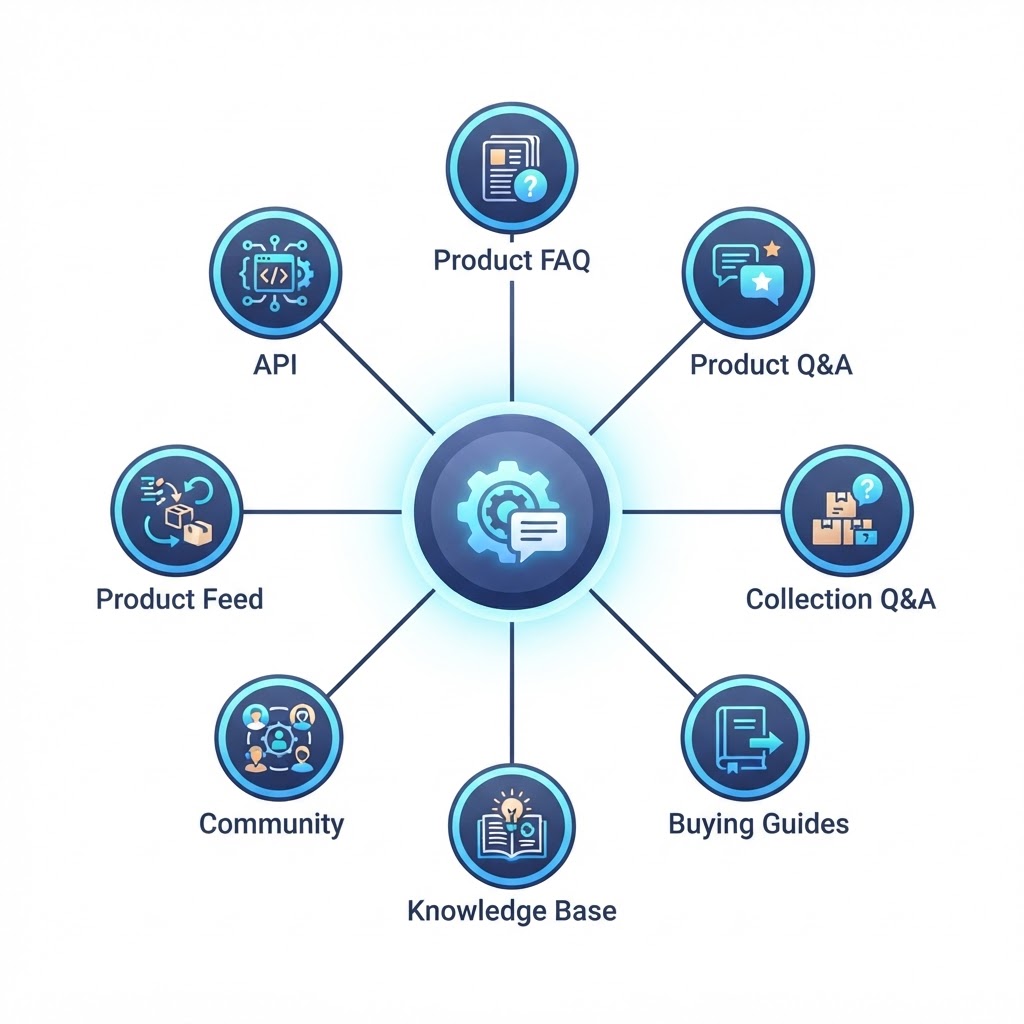
An answer that lives in one place only reaches one audience. The same canonical answer, distributed across product pages, FAQs, buying guides, knowledge bases, communities, product feeds, and APIs, reaches every audience that will ever ask the same question — today and for years to come.
How Answerbase Automates This Process
Everything above is a philosophy before it is a product. Answerbase is the platform that operationalizes it — turning customer questions into Product Knowledge at scale. Here is how the pieces fit together. The purpose here is education first; each capability links to its own page if you want to go deeper.
Frequently Asked Questions
The core questions about why customer questions are valuable and how they become Product Knowledge.
Read the next chapter
Each chapter builds on the previous one, guiding you from the evolution of search to building a complete Product Knowledge strategy.
See how Answerbase fits your product knowledge strategy
This is one part of the Answerbase Product Knowledge platform. Request a demo to see how every capability works together.
