From Customer Questions to Product Knowledge:
Building a Competitive Advantage That Compounds
Most businesses answer questions. Very few businesses build Product Knowledge. Content should be created to help people, not to manipulate rankings. The natural evolution of that philosophy is Product Knowledge — a continuously improving asset that serves customers, search engines, AI systems, and the business itself. The competitive advantage isn't answering one question. It is continuously growing a Product Knowledge ecosystem.
Most Businesses Answer Questions... Then Lose Them
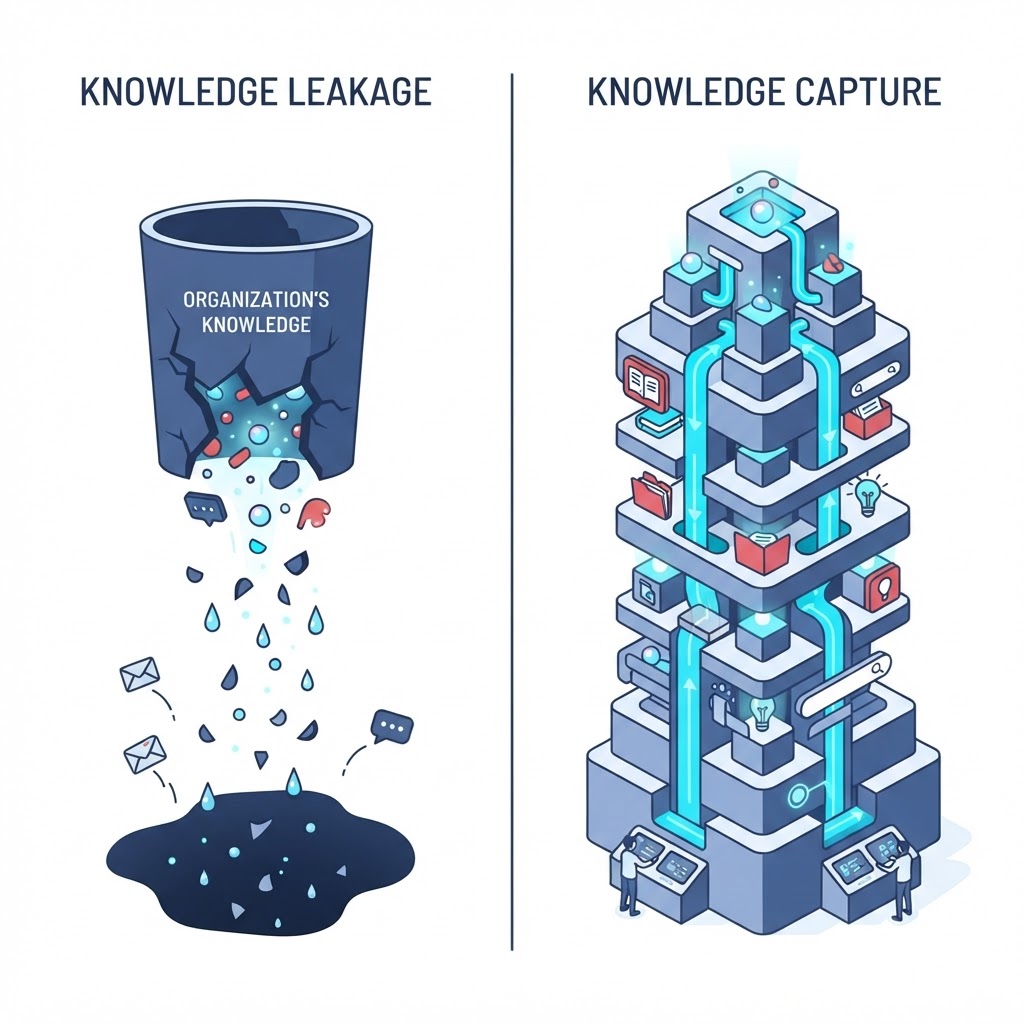
Every day, across every business, valuable knowledge is created and then destroyed. A customer asks a question. Someone answers it well. And then the answer disappears — trapped inside a system no future customer will ever search. This as a fundamental waste. The expertise exists. The demand exists. The only thing missing is a system that captures the answer and lets it work forever.
Support Tickets
Answered once, then buried in a closed ticket no one will ever see again.
Emails
Replied to, then lost in an inbox forever.
Chats
Resolved in real time, then the transcript vanishes.
Phone Calls
Handled verbally, with no record of the answer at all.
Sales Conversations
Objections overcome in a demo, never captured for the next buyer.
Store Associates
Knowledge lives in the head of the person on the floor.
Slack & Teams
Answered in a channel, then scrolled away into history.
Individual Employees
Expertise that walks out the door when someone leaves.
This knowledge disappears every day. The same questions get answered again and again — by different people, in different channels, to different customers. The business pays for the same work repeatedly, and the answers never accumulate into an asset. Product Knowledge changes this by capturing every answer once and letting it compound.
Product Knowledge Changes Everything
Content should be created to help people. Product Knowledge is what happens when you take that philosophy seriously. It is not documentation — a static manual that goes out of date. It is continuously improving expertise surrounding your products, captured from the people who know them best and made available to everyone who needs them. And unlike traditional content, it becomes more valuable over time.
Compatibility
Which products work together and which do not.
Buying Advice
Which option is right for a specific customer need.
Installation
How to set up the product correctly the first time.
Warranty
What is covered, for how long, and under what conditions.
Troubleshooting
How to diagnose and resolve common issues.
Maintenance
How to keep the product working over its lifetime.
Real-World Experience
Insights from people who have actually used the product.
Customer Insights
What buyers consistently need to know before purchasing.
Expert Recommendations
Guidance from specialists closest to the product.
Product Knowledge becomes increasingly valuable over time. Traditional content decays — it goes stale, gets abandoned, and loses rankings. Product Knowledge compounds — every new question, every new answer, and every new expert contribution makes the whole ecosystem more useful, more visible, and more defensible. It is an asset that appreciates rather than depreciates.
The Product Knowledge Flywheel
A disciplined process: understand demand, create helpful content, measure results, and improve. Product Knowledge turns that process into a flywheel — a self-reinforcing cycle where every answered question generates more engagement, more demand signals, and more knowledge. This is why it compounds over years rather than campaigns. Each turn of the wheel makes the next turn easier and more valuable.
Customer Demand
Buyers reveal what they need to know through real interactions.
Customer Questions
Questions are captured from every channel where customers ask.
Knowledge Gap
Each question identifies a gap in your current Product Knowledge.
AI Draft
AI generates a first draft from existing product data and context.
Expert Contribution
The qualified specialist adds real experience and corrects the draft.
Canonical Product Knowledge
A single authoritative answer becomes the source of truth.
Published Everywhere
Distributed across product pages, FAQs, descriptions, and AI-ready formats.
More Customer Engagement
Published answers generate more questions and more demand signals.
More Demand Signals
New questions reveal new gaps and new opportunities.
Even Better Product Knowledge
The cycle repeats — and the knowledge base grows stronger.
This is why the flywheel compounds over years, not campaigns. Traditional content marketing is linear: you create a piece, promote it, and move on. Product Knowledge is circular: every answer you publish generates new questions, new demand signals, and new knowledge — which feeds the next cycle. The longer you run it, the faster it accelerates.
Why Product Knowledge Outperforms Traditional Content
A clear line can be drawn between content created for search engines and content created for people. Product Knowledge is the fullest expression of the people-first side of that line. Traditional content marketing and Product Knowledge are not just different tactics — they are different philosophies, with different lifespans, different audiences, and different returns.
Traditional Content Marketing
Campaign based
Blog focused
Keyword focused
Often abandoned
Limited reuse
Decays over time
Product Knowledge
Continuous
Customer driven
Reusable everywhere
Expands over time
Supports AI search
Supports Google search
Supports customers
Supports employees
Content creates pages. Product Knowledge creates competitive advantages. A blog post is a single asset with a limited lifespan. A piece of Product Knowledge is a reusable, continuously improving asset that powers product pages, FAQs, descriptions, support, sales, search, and AI — all at once, and for years.
Every Department Benefits
People-first content serves the customer first — but the ripple effect is that it serves the entire business. Product Knowledge becomes shared organizational intelligence. Marketing reuses it. SEO ranks it. Support deflects with it. Sales closes with it. Merchandising informs with it. Every department that touches the customer benefits from the same canonical answers.
Marketing
Reusable knowledge instead of one-off campaigns.
SEO
Demand-driven content that earns rankings and stays.
Customer Support
Answers published once, never answered again.
Sales
Published objection-handlers that close deals.
Merchandising
Knowledge that informs product presentation.
Retail
Associates equipped with expert answers on the floor.
Product Teams
Real customer demand feeding product decisions.
Customers
Self-service answers at the moment of decision.
AI Search
Authoritative knowledge AI engines retrieve and cite.
Google Search
Helpful content that earns visibility and trust.
Product Knowledge becomes shared organizational intelligence. When every department draws from the same canonical answers, the business speaks with one voice. The support team, the sales team, and the product page all tell the same story — because they are all powered by the same knowledge.
Product Knowledge Is Never Finished
Google "continues to get more sophisticated in their ability to digest the feedback from their Search Quality Raters and adjust their automated ranking signals." Product Knowledge works the same way — it continuously evolves. Unlike traditional content, which is published and then abandoned, Product Knowledge is never finished. Every interaction strengthens the knowledge base.
New Products
Each new product introduces new questions and new knowledge to capture.
New Customer Questions
Every unanswered question is an opportunity to grow the knowledge base.
New Compatibility Issues
As your catalog grows, compatibility knowledge becomes more valuable.
New AI Insights
AI surfaces new demand signals and new content opportunities continuously.
New Buying Trends
Shifting demand reveals new questions buyers need answered.
New Reviews
Customer feedback surfaces new insights and new knowledge gaps.
New Expert Contributions
Every expert answer strengthens the canonical knowledge base.
Every interaction strengthens the knowledge base. A new product launch, a new customer question, a new review, a new expert answer — each one is an input that makes the whole ecosystem richer. The businesses that treat Product Knowledge as a living system, rather than a one-time project, are the ones that build a defensible advantage.
How Answerbase Builds Product Knowledge
Everything above is a philosophy before it is a product. Answerbase is the platform that operationalizes it — turning the Product Knowledge flywheel into a repeatable, measurable practice. Every capability in the platform supports one stage of this lifecycle. Here is how the pieces fit together.
Understand Customer Demand
Capture and measure the questions customers actually ask across every channel.
Identify Knowledge Gaps
Compare what customers need to know against what your content already answers.
Generate AI Drafts
AI creates first drafts from existing product data, context, and demand signals.
Capture Expert Knowledge
Route drafts to the qualified specialists closest to each product for review.
Publish
Distribute canonical answers across product pages, FAQs, descriptions, and more.
Measure
Track engagement, rankings, conversions, and AI visibility tied to each answer.
Improve
Feed results back in to prioritize the next knowledge gap and strengthen the base.
Product Knowledge Powers Everything
Product Knowledge is not another channel — it is the central asset that powers every channel. One canonical answer feeds product FAQs, collection FAQs, knowledge bases, communities, product pages, product descriptions, buying guides, product feeds, developer APIs, AI search, and Google search. The answer is created once. It is published everywhere. It works forever.
Content creates pages. Product Knowledge creates competitive advantages. Every customer interaction is an opportunity to grow an asset that continuously improves AI visibility, search visibility, customer experience, and business performance.
Frequently Asked Questions
The core questions about what Product Knowledge is, how it differs from content, and why it builds a compounding competitive advantage.
Read the next chapter
Each chapter builds on the previous one, guiding you from the evolution of search to building a complete Product Knowledge strategy.
See how Answerbase fits your product knowledge strategy
This is one part of the Answerbase Product Knowledge platform. Request a demo to see how every capability works together.
