The Product Knowledge Organization:
Why The Next Generation of Companies Will Compete on Knowledge
Businesses that help people — not manipulate rankings — are rewarded for years to come. That principle has expanded from a search strategy into an organizational philosophy. Product Knowledge is no longer a marketing initiative. It becomes an organizational capability. The companies that continuously discover, capture, improve, distribute, and measure Product Knowledge will outperform competitors across every channel — because knowledge, not content, is what compounds.
The Traditional Organization vs. The Product Knowledge Organization
Content created without first-hand knowledge is exactly what search engines increasingly ignore. The same is true of organizations. A traditional organization siloes knowledge — each department guards its own expertise, and when people leave, knowledge leaves with them. A Product Knowledge Organization does the opposite: it captures expertise from every source, shares it across every team, and compounds it through continuous learning and improvement. The difference is not incremental. It is structural.

Traditional Organization
Traditional Organization
Each department operates independently with its own tools and goals.
Siloed Knowledge
Expertise stays trapped in tickets, emails, and individual heads.
Lost Expertise
When people leave, knowledge leaves with them — permanently.
Product Knowledge Organization
Product Knowledge Organization
Every department contributes to and draws from shared knowledge.
Shared Intelligence
Expertise is captured once and made available to every team.
Continuous Learning
The organization learns from every customer interaction.
Continuous Improvement
Measurement feeds back into the next cycle of knowledge building.
Product Knowledge Becomes Every Capability
People-first content serves the customer first — and the ripple effect is that it serves the entire business. In a Product Knowledge Organization, that ripple becomes structural. Product Knowledge is not a marketing asset alone. It becomes customer experience, SEO, AI visibility, employee training, sales enablement, customer support, product development, competitive intelligence, institutional memory, and enterprise value — all from the same growing asset, all compounding together.
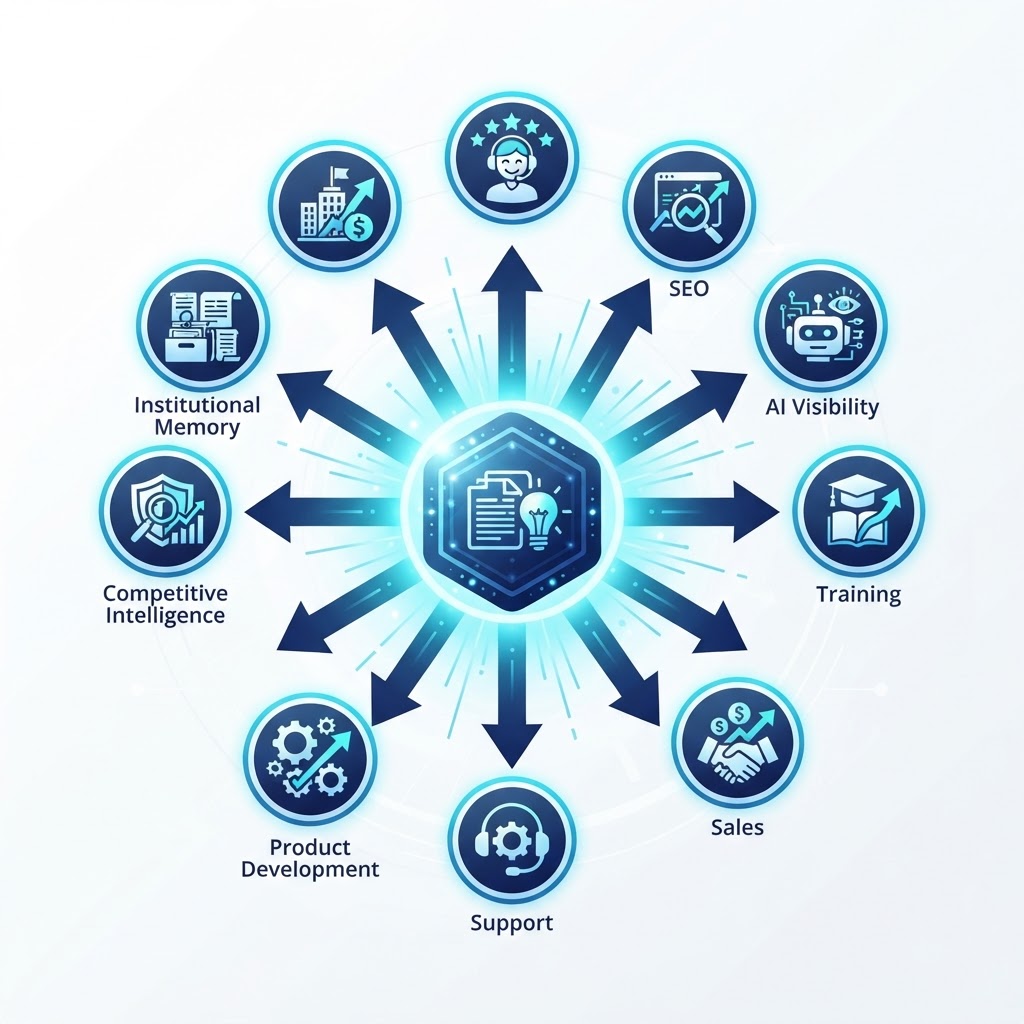
One asset becomes every capability. A single expert answer can simultaneously improve customer experience, rank in search, get cited by AI, train an employee, help a sales rep, deflect a support ticket, inform a product decision, reveal a competitive gap, preserve institutional memory, and increase enterprise value. This is the multiplier effect that makes the Product Knowledge Organization fundamentally different from any traditional structure.
The Product Knowledge Operating System
A disciplined process of understanding demand, creating helpful content, measuring results, and improving. In a Product Knowledge Organization, that process becomes an operating system — a continuous, automated, measured cycle that runs across every department and every product. Customer demand flows in, knowledge is captured and refined, answers are distributed everywhere, results are measured, and the system improves itself. This is not a campaign. It is how the organization runs.
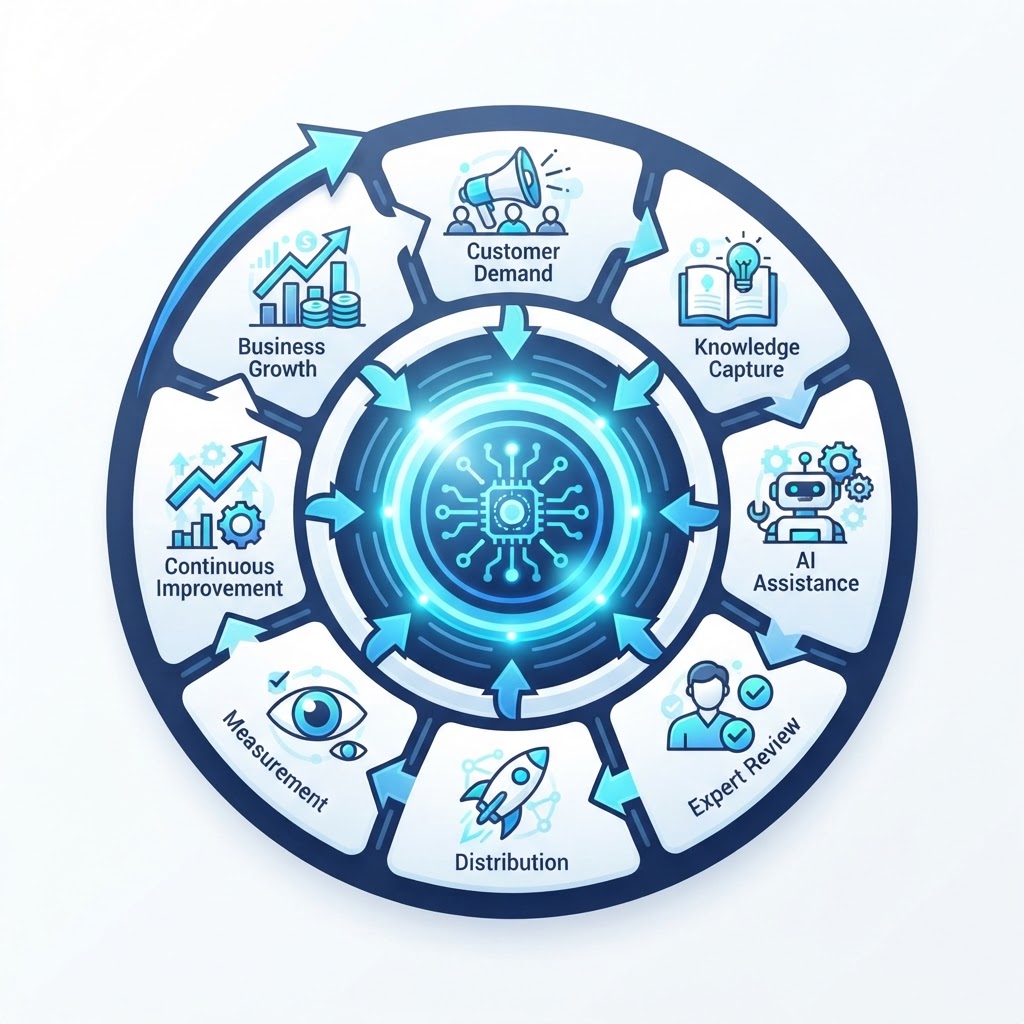
Customer Demand
Capture questions and demand from every channel where customers interact.
Knowledge Capture
Route questions to the right experts and capture their first-hand answers.
AI Assistance
AI drafts, summarizes, and recommends — accelerating capture at scale.
Expert Review
Experts validate, refine, and approve every answer before publication.
Distribution
Publish canonical answers across every channel and format simultaneously.
Measurement
Track coverage, gaps, demand fulfilled, and business value continuously.
Continuous Improvement
Feed results back to prioritize the next gap and strengthen the base.
Business Growth
The compounding asset drives revenue, trust, authority, and competitive advantage.
This is not a campaign — it is how the organization runs. The operating system runs continuously, automatically, and across every department. Every cycle makes the knowledge base larger, deeper, and more valuable. Every cycle teaches the organization where the next opportunity remains. The businesses that run this operating system will compound their advantage faster than competitors can respond.
Every Answerbase Capability Fits The Operating Model
A disciplined process of understanding demand, creating helpful content, measuring results, and improving. Answerbase is the platform that operationalizes that process — and every capability maps to a specific stage of the Product Knowledge Operating System. Together, these capabilities turn the operating model from a philosophy into a daily practice your organization can run automatically.
Every capability serves the operating model. None of these tools exist in isolation. Each one feeds the next stage of the cycle, and the measurement stage feeds back to the beginning — so the system learns from itself and compounds over time. This is what makes Answerbase an operating system rather than a collection of features.
Every Department Contributes
Great content is built by people with deep, first-hand knowledge — not by people guessing at what might rank. In a Product Knowledge Organization, that principle becomes structural: every department contributes to and draws from the same knowledge ecosystem. Marketing, support, engineering, sales, retail, merchandising, customers, community, and AI all strengthen the Product Knowledge base — and all benefit from it. No single team owns the knowledge. The entire organization does.
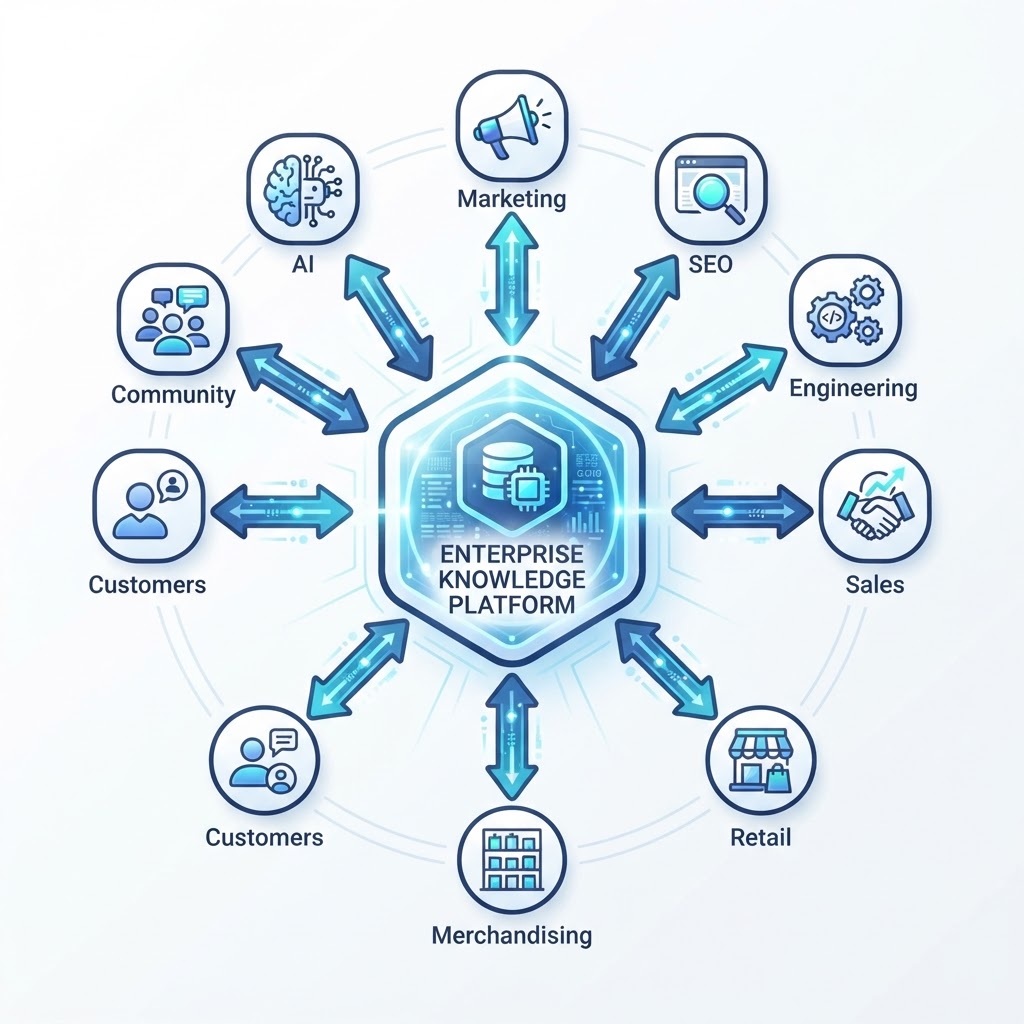
Marketing
Authentic knowledge for campaigns that resonate with real buyer needs.
SEO
Expertise-based content that earns and maintains search rankings.
Engineering
Technical specifications and design rationale captured permanently.
Sales
Objection handling and buying guidance available to every rep.
Retail
In-store associates access the same knowledge as online teams.
Merchandising
Category knowledge informs product grouping and recommendations.
Customers
Authentic post-purchase experience and tips shared with everyone.
Community
Peer-to-peer discussions and shared solutions that compound.
AI
Structured knowledge feeds AI assistants and search engines.
Everyone strengthens the Product Knowledge ecosystem. Tomorrow's leading companies will not simply have better products. They will possess better Product Knowledge — and that knowledge is built by every person and every system that touches the customer experience. No single team can create it alone. The entire organization must contribute.
The Complete Product Knowledge Curriculum
This article is the conclusion of a curriculum that began with a single question: why did search change? Each resource built on the last — from the future of search, to customer questions, to the Product Knowledge flywheel, to expertise and Information Gain, to strategy, to measurement, to capture, to the business asset. Together, they form a complete philosophy. Read them in order, or revisit any chapter to deepen your understanding.
Frequently Asked Questions
The core questions about the Product Knowledge Organization and why the next generation of companies will compete on knowledge.
The Final Thought
"The companies that dominate the next decade won't simply know more. They will become dramatically better at continuously learning from customers, capturing expertise, improving Product Knowledge, and making that knowledge available wherever customers search, shop, ask questions, or use AI."
Explore the Platform
The curriculum is complete. The next step is to make it operational. Explore the four pillars of the Answerbase platform — the capabilities that turn this philosophy into a daily practice your organization can run automatically.
Understand Demand
Capture customer and search demand across every channel.
Build Knowledge
Generate, refine, and capture expertise as Product Knowledge.
Distribute Knowledge
Publish canonical answers across every channel and format.
Measure & Improve
Track the health and value of your knowledge asset continuously.
See how Answerbase fits your product knowledge strategy
This is one part of the Answerbase Product Knowledge platform. Request a demo to see how every capability works together.
