How to Measure Product Knowledge:
Beyond Rankings, Traffic & Content Volume
Vanity metrics — content that makes companies feel good with impressions and clicks but delivers no real conversion attribution — should be rejected. Rankings, traffic, pages, keywords, and articles tell a business how much content it has produced. None of them tell a business whether customers are actually receiving the knowledge they need. Product Knowledge is different: it can and should be measured — not by how much you publish, but by how effectively you satisfy customer demand and build a compounding asset.
Why Traditional SEO Metrics Fall Short
Many companies feel good about content that generates impressions and clicks but delivers no real conversion attribution. Traditional SEO metrics measure marketing activity, not customer success. They tell you how much content you produced and how many times it was seen. They do not tell you whether a buyer found the knowledge they needed, whether a question was answered, or whether a purchase was enabled. These metrics are not wrong — they are simply incomplete.
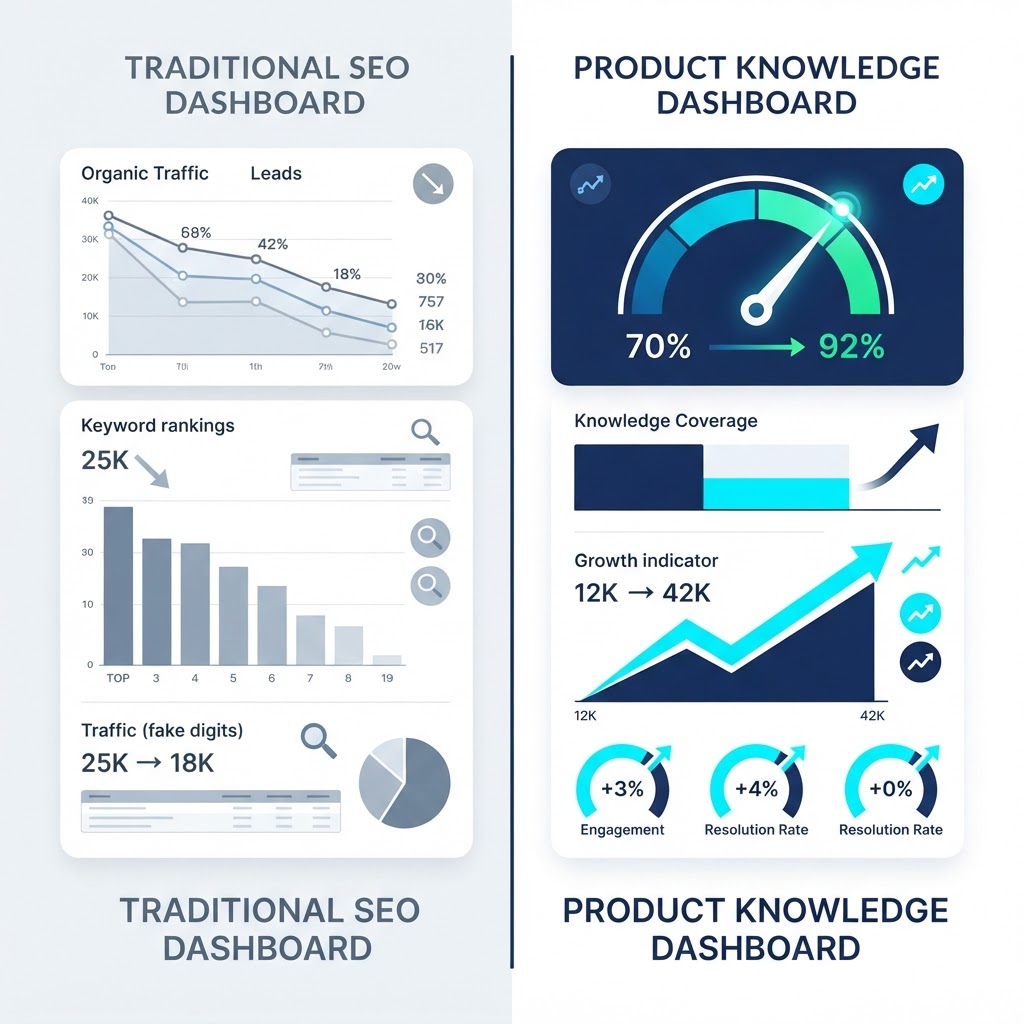
Keyword Rankings
Where you rank for a keyword says nothing about whether the customer got their answer.
Traffic
A visit does not mean the buyer found the knowledge they needed to make a decision.
Pageviews
A page was viewed, but was it helpful? Was the question actually answered?
Impressions
An impression measures visibility, not value — it tells you nothing about customer success.
Average Position
A high position for the wrong query helps no one and drives no revenue.
Content Volume
Publishing 50 pages means you published 50 pages. It does not mean you helped 50 customers.
These metrics don't necessarily indicate customer success. A page can rank first, receive thousands of visits, and generate piles of impressions — and still fail to answer the question the buyer actually needed answered. The philosophy demands a better signal: are we helping people? Product Knowledge measurement provides it.
What Actually Matters
Content should be created to help people, not to manipulate rankings. Measurement should follow the same principle. Instead of measuring how much content you publish, measure how effectively you satisfy customer demand. These modern Product Knowledge metrics represent business value rather than marketing activity — they tell you whether your knowledge asset is growing, whether gaps are closing, and whether buyers are getting what they need.
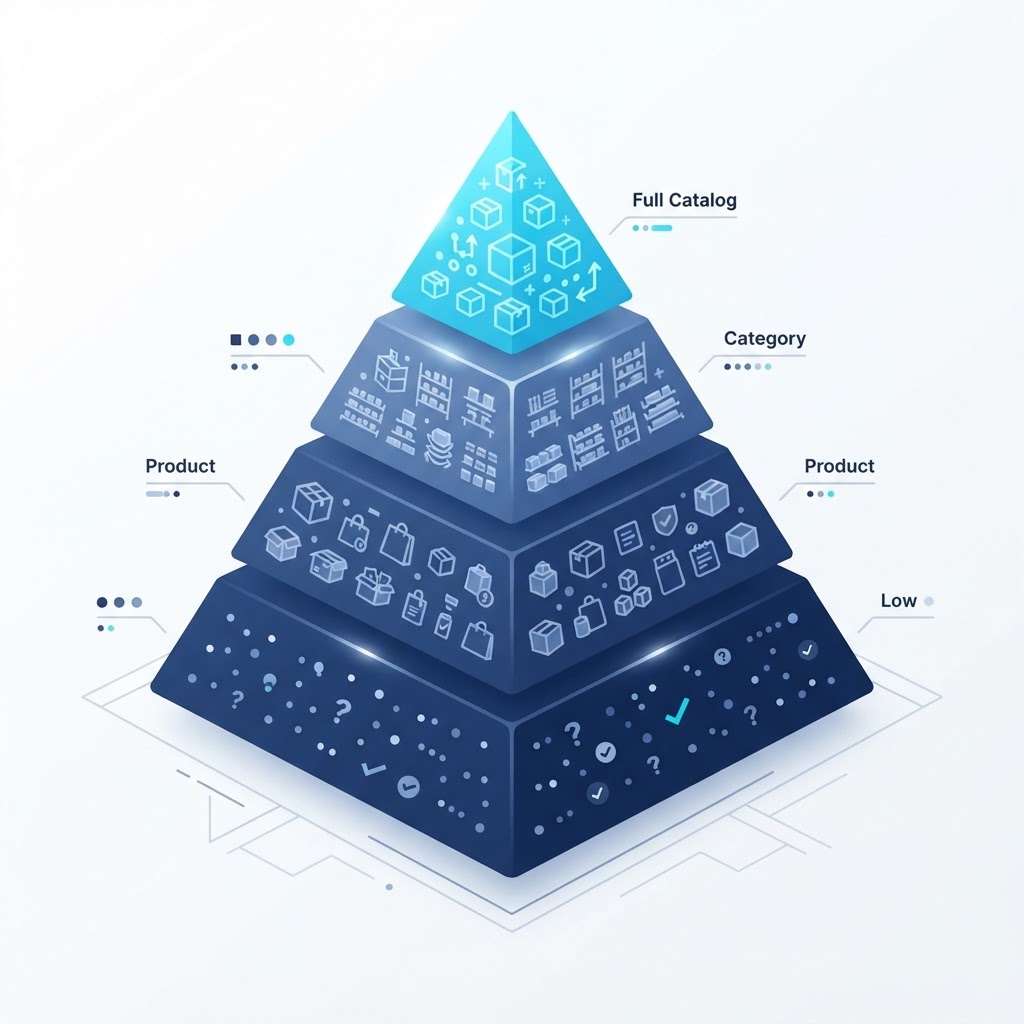
Customer Demand Covered
What percentage of real buyer questions do you actually answer?
Knowledge Coverage
How much of your catalog has published Product Knowledge?
Knowledge Gaps
Where does customer demand exceed your current knowledge?
Question Coverage
Are the questions buyers ask being answered?
Product Coverage
Does each product have the knowledge it needs to sell?
Category Coverage
Do your category pages answer broader buying questions?
Demand Fulfillment
Is the demand customers bring actually being fulfilled?
Knowledge Freshness
Is your knowledge current or going stale?
Knowledge Quality
Does your knowledge genuinely help buyers decide?
Knowledge Growth
Is your knowledge base expanding over time?
These represent business value rather than marketing activity. A ranking tells you a page exists in search results. Knowledge Coverage tells you whether your products have the knowledge they need to sell. A pageview tells you someone visited. Demand Fulfillment tells you whether that visitor actually got their question answered. These are the metrics that correlate with revenue, not just traffic.
The Product Knowledge Scorecard
A disciplined process of measuring results and improving. The Product Knowledge Scorecard is what that process looks like in practice — a single view that measures the health, coverage, and business value of your knowledge asset. Instead of reporting rankings and traffic, it reports demand covered, gaps remaining, opportunities prioritized, and business outcomes achieved. This is the dashboard that tells you whether your Product Knowledge is actually improving.
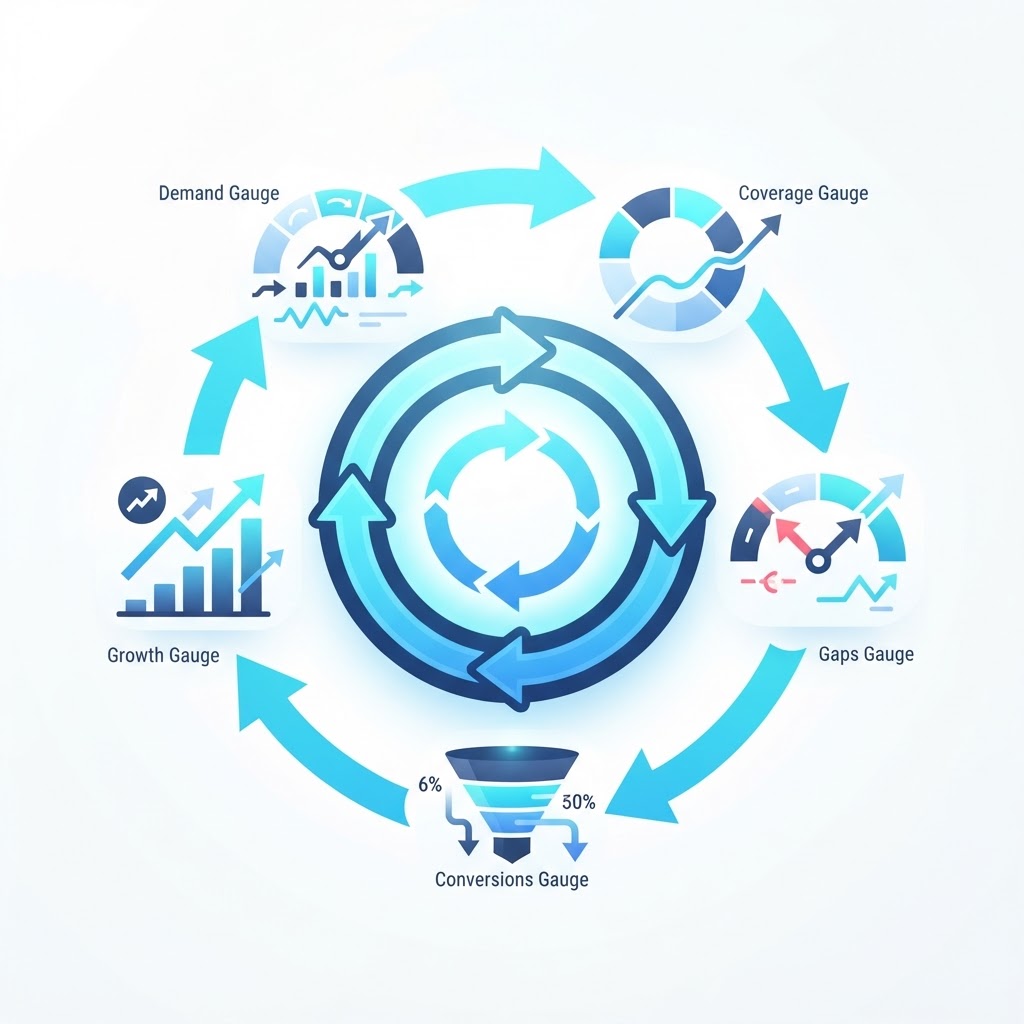
Customer Demand
Total volume of real buyer questions and demand signals captured.
High
Knowledge Coverage
Percentage of catalog with published Product Knowledge.
64%
Knowledge Gap Score
How much demand remains unaddressed by current knowledge.
36%
Opportunity Score
Prioritized value of remaining knowledge gaps.
High
AI Visibility
Whether AI engines retrieve and cite your knowledge.
Growing
Search Visibility
Whether your knowledge earns and maintains rankings.
Growing
Conversion Attribution
Revenue tied directly to answered questions.
7.5%
Support Reduction
Tickets deflected by published answers.
−42%
Customer Confidence
Whether buyers feel informed enough to purchase.
Rising
Product Knowledge Growth
Net new knowledge added over time.
+18%
This is the dashboard that tells you whether your Product Knowledge is actually improving. Every metric measures the asset, not the activity. When Knowledge Coverage rises, Knowledge Gaps fall, and Conversion Attribution grows, you know your strategy is working — regardless of what rankings and traffic alone might suggest.
Every Customer Interaction Creates Measurement
Google "continues to get more sophisticated in their ability to digest the feedback from their Search Quality Raters and adjust their automated ranking signals." Product Knowledge measurement works the same way — every customer interaction is feedback that creates measurable signal. A question reveals a gap. A gap becomes an opportunity. An answer creates engagement. Engagement creates conversion. And every step teaches the business where the next opportunity remains.
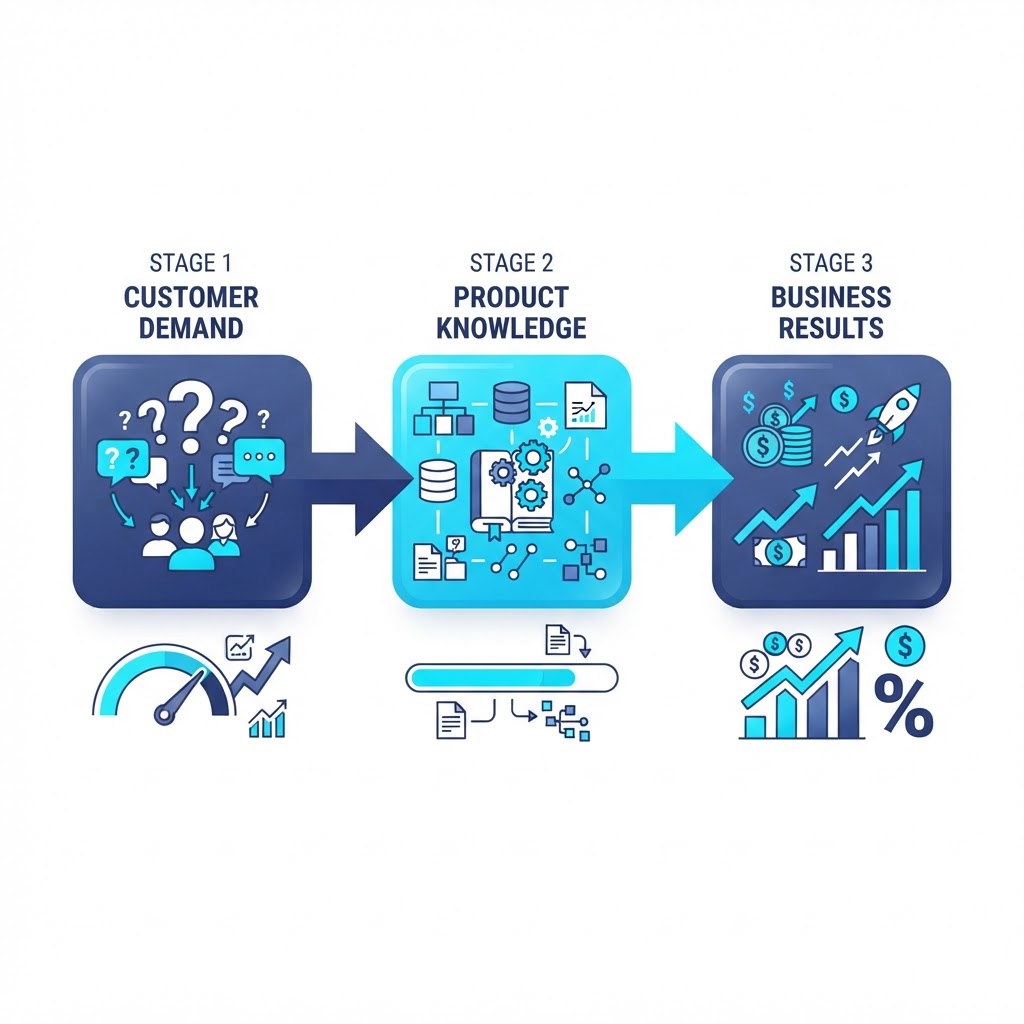
Customer Question
A buyer asks something your current content does not answer.
Knowledge Gap
The question reveals a measurable gap in your Product Knowledge.
Knowledge Created
Expertise is captured and published as a canonical answer.
Customer Engagement
Buyers engage with the answer, generating new demand signals.
Conversion
The answered question enables a purchase that would not have happened.
Future Demand
Engagement surfaces new questions and new opportunities.
Continuous Measurement
Every interaction is measured, feeding the next cycle of improvement.
Product Knowledge continuously teaches the business where opportunities remain. Every question is a measurement. Every gap is a signal. Every conversion is proof. The businesses that capture and act on these signals improve faster than the businesses that rely on rankings and traffic alone.
Business Outcomes
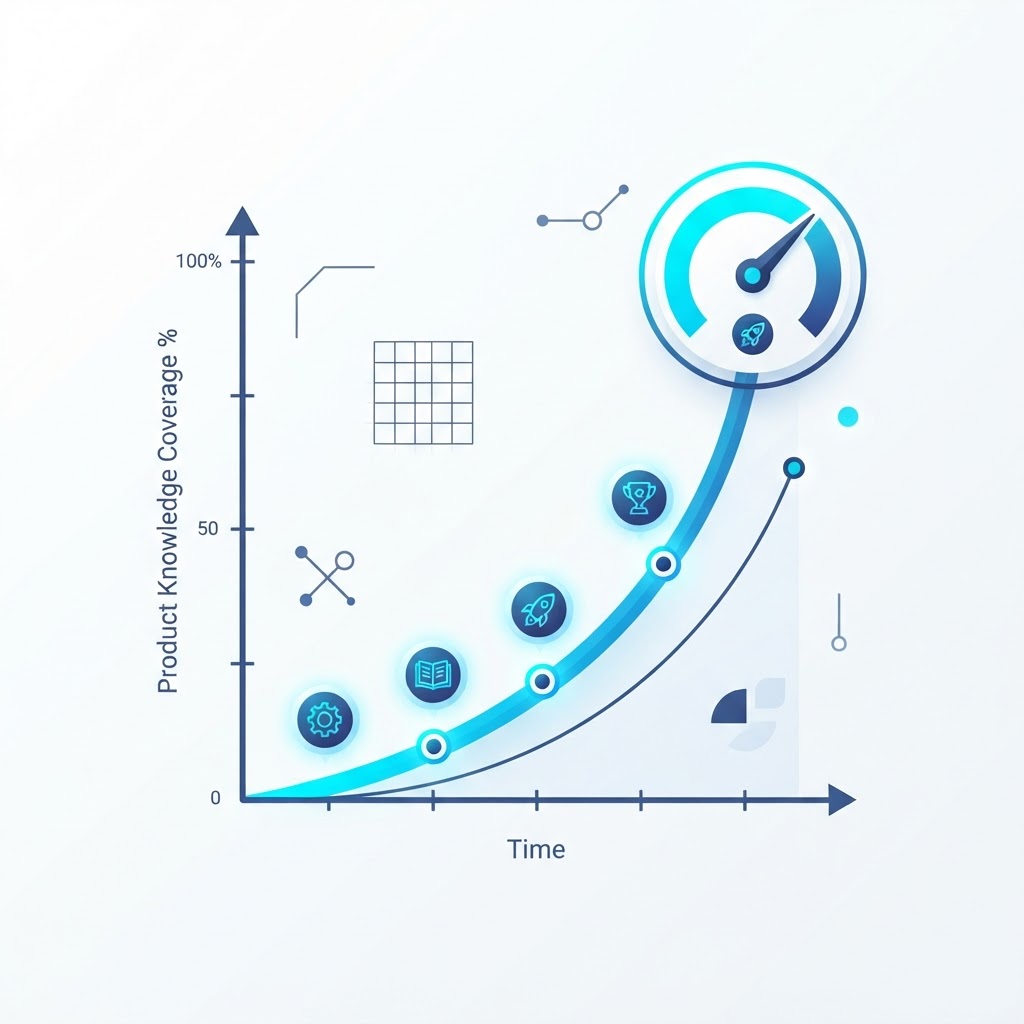
People-first content serves the customer first — and the ripple effect is that it serves the entire business. Product Knowledge measurement ultimately connects to business outcomes, not just marketing metrics. When you measure Product Knowledge properly, you can see whether it is improving customer confidence, revenue, conversion rate, organic visibility, AI visibility, support efficiency, knowledge retention, employee productivity, and merchant authority — all from the same growing asset.
Customer Confidence
Buyers feel informed enough to commit.
Revenue
Answered questions drive measurable sales.
Conversion Rate
Knowledge at the moment of decision removes friction.
Organic Visibility
Helpful knowledge earns persistent rankings.
AI Visibility
Authoritative answers get retrieved and cited.
Support Efficiency
Published answers deflect tickets permanently.
Knowledge Retention
Expertise is captured, not lost.
Employee Productivity
Shared knowledge replaces repetitive answers.
Merchant Authority
Your business becomes the trusted source.
Product Knowledge should ultimately improve all of these. A single piece of Product Knowledge works for SEO, AI, support, sales, and the customer simultaneously. The ROI is not measured in one channel but across all of them — and Product Knowledge measurement is what makes that ROI visible.
Introducing Product Knowledge Intelligence
Content that makes companies feel good but delivers no real conversion attribution should be rejected. Product Knowledge Intelligence is the natural evolution of SEO reporting — it replaces activity metrics with asset metrics. Instead of reporting how much you published, it reports how much demand you covered, how many gaps you closed, and how much business value you created. This is the measurement system that tells you whether your Product Knowledge is actually compounding.
Old Reporting
Instead of reporting:
"We published 50 pages."
This tells you how much content you produced. It says nothing about whether customers were helped, whether gaps were closed, or whether revenue was generated.
Product Knowledge Intelligence
Report:
"We closed 18% of our highest-value knowledge gaps."
This tells you whether your knowledge asset grew, whether customer demand was fulfilled, and whether your highest-value opportunities were addressed. It is a business metric, not a marketing metric.
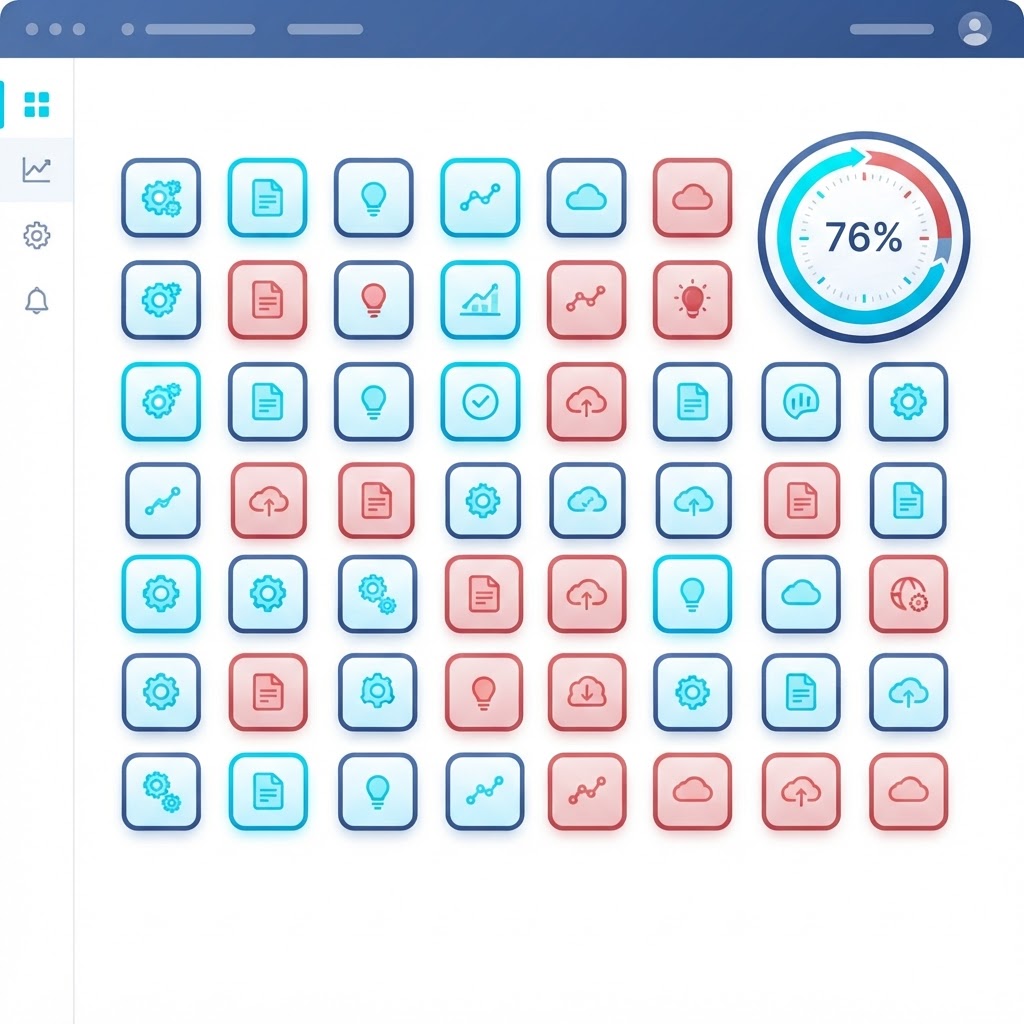
This represents a much more meaningful business metric. "We published 50 pages" is an activity. "We closed 18% of our highest-value knowledge gaps" is an outcome. Product Knowledge Intelligence measures outcomes — coverage, quality, gaps closed, demand fulfilled, and business value created. Explore Product Knowledge Intelligence →
How Answerbase Measures Product Knowledge
A disciplined process of measuring results and improving. Answerbase is the platform that makes that process operational. Every measurement guides merchants toward their highest-value opportunities — so effort is always invested where it creates the most business value, not where it produces the most content volume.
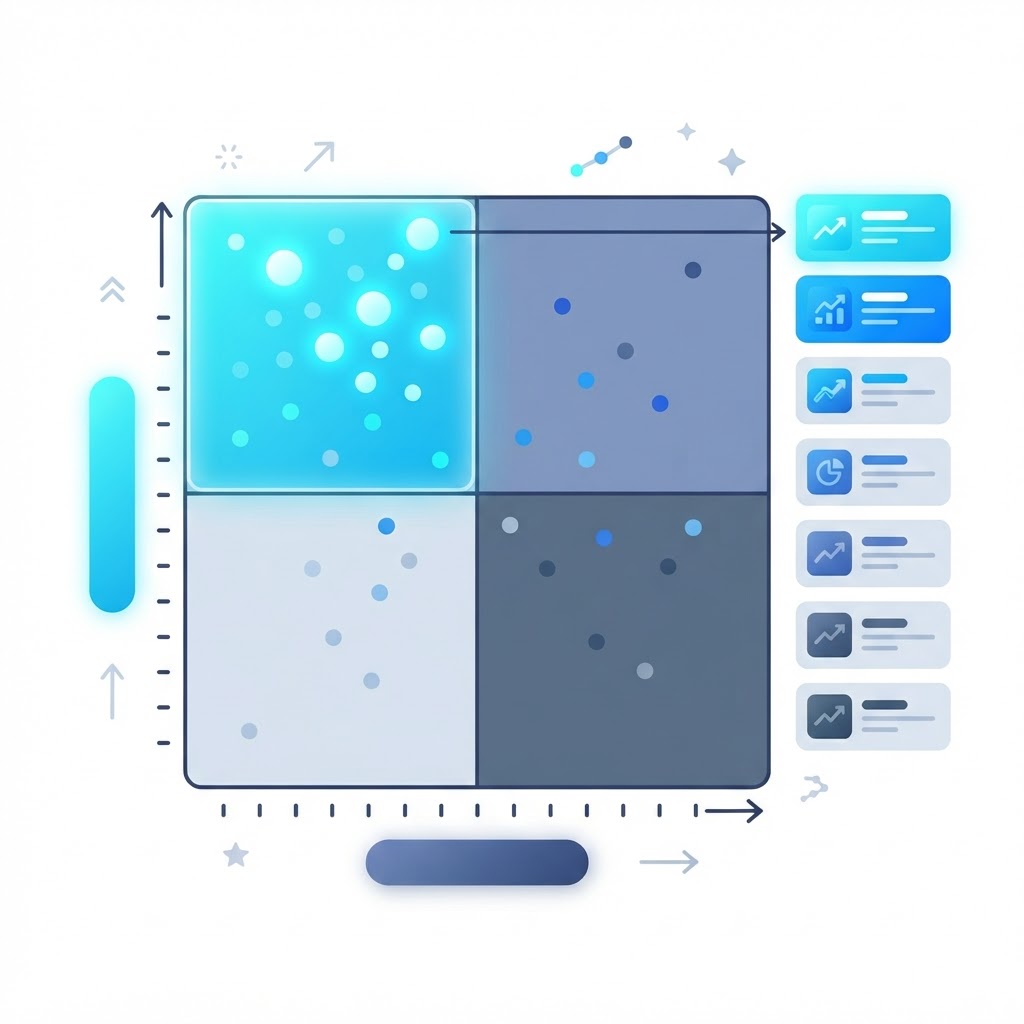
These measurements guide merchants toward their highest-value opportunities. Instead of guessing what to write next, you follow the data: the Demand Score tells you what buyers need, the Knowledge Gap Score tells you what is missing, and the Opportunity Score tells you which gap to close first. Measurement becomes strategy.
The Future of Measurement
Businesses helping people would be rewarded by search engines for years to come. That conclusion has expanded to every AI system. AI search will increasingly reward businesses that continuously improve Product Knowledge. The businesses that can measure it will improve it faster. The businesses that improve it faster will ultimately outperform competitors. What gets measured gets improved — and in the AI search era, what gets improved wins.

AI search will reward continuous improvement
AI systems increasingly reward businesses that continuously improve Product Knowledge — not businesses that publish once and abandon.
Measurement enables faster improvement
Businesses that can measure Product Knowledge can see their gaps, prioritize their opportunities, and close them faster than competitors.
Faster improvement wins
Businesses that improve their Product Knowledge faster will ultimately outperform competitors in AI search, traditional search, and customer trust.
What gets measured gets improved
The businesses that measure Product Knowledge are the businesses that improve it — and the businesses that improve it are the ones that win.
The future belongs to businesses that don't simply create more content — they systematically measure, improve, and expand their Product Knowledge. What gets measured gets improved, and businesses that improve their Product Knowledge faster will ultimately win AI search, traditional search, and customer trust.
Frequently Asked Questions
The core questions about measuring Product Knowledge, knowledge coverage, knowledge gaps, and what metrics matter after Helpful Content.
Explore the Platform
This concludes the strategic educational series. The next step is to explore the platform capabilities that bring this strategy to life — from understanding demand to building, distributing, and continuously measuring Product Knowledge.
Understand Demand
Capture customer and search demand across every channel.
Build Knowledge
Generate, refine, and capture expertise as Product Knowledge.
Distribute Knowledge
Publish canonical answers across every channel and format.
Measure & Improve
Track the health and value of your knowledge asset continuously.
See how Answerbase fits your product knowledge strategy
This is one part of the Answerbase Product Knowledge platform. Request a demo to see how every capability works together.
