The Future of Search:
Why Product Knowledge Replaced Traditional SEO
The evolution of search was never about rewarding more content. It was about rewarding better knowledge. Google's Helpful Content initiative was an early signal that search engines wanted content created to genuinely help customers rather than manipulate rankings — and AI search has accelerated that evolution. Today the winners are organizations that continuously understand customer demand, capture expert knowledge, build authoritative Product Knowledge, distribute it effectively, and continuously improve it.
The Search Landscape Changed
The fundamental problem in how content was being created — and why Google needed to act — was visible long before these updates. What followed — the Helpful Content Update, the Helpful Content System, and eventually AI search — was not a series of surprises. It was the predictable consequence of a search engine finally able to detect and reward what it always wanted.
Traditional SEO content was failing searchers
A disproportionate amount of content was being created for the company rather than the customer. Google's Search Liaison Danny Sullivan characterized this succinctly: "Buckle up." His clarification — that those making good people-first content should be fine — implied clearly that those who were not would face consequences. The Helpful Content Update and its incorporation into Core Ranking Systems was the mechanism.
"There's so much coming that I don't want to say buckle up, because those who are making good, people-first content should be fine. But that said, there's a lot of improvements on the way."
— Google's Search Liaison, Danny Sullivan
Keyword-first processes created search-engine-first content
The standard SEO workflow — keyword research, volume analysis, content creation — was producing content that served the company's ranking goals, not the customer's information needs. Google's Search Quality Ratings Guidelines classify this as Lowest Quality Content: "beneficial to the website owner but not necessarily the website visitor." The process needed to be inverted.
Google needed a way to reward genuinely helpful content
With 80% of searches being for information, Google's ranking systems needed to incentivize high-quality, satisfying informational content. The Helpful Content System created that incentive by making helpfulness a direct ranking signal — rewarding content where visitors feel they've had a satisfying experience.
"The helpful content system aims to better reward content where visitors feel they've had a satisfying experience, while content that doesn't meet a visitor's expectations won't perform as well."
— Google Helpful Content System Announcement
AI search accelerated the same correction
AI systems like Google AI Overviews, ChatGPT, Gemini, Claude, and Perplexity do not return a list of links to browse — they synthesize an authoritative answer. Generic marketing copy provides no value worth synthesizing — so AI systems have no reason to retrieve or cite it. Only content that demonstrates real expertise, answers real questions, and provides original insight gets retrieved and cited. The same correction Google started has now widened across every search surface.
What Google Was Actually Trying To Solve
The Helpful Content Update is easy to misread as a penalty for low-quality content. It is more accurate to read it as a reward structure for high-quality content — specifically the kind that has always satisfied search intent but was not being reliably created. Understanding Google's actual objective explains every update that followed.
Google is not rewarding rankings — it is rewarding satisfying experiences
The Helpful Content Update and Helpful Content System both communicated the same goal in nearly identical language: "better reward content where visitors feel they've had a satisfying experience." This is not an algorithm change. It is a statement about what Google was always trying to do — and now finally had the signals to achieve.
"The helpful content update aims to better reward content where visitors feel they've had a satisfying experience, while content that doesn't meet a visitor's expectations won't perform as well."
— Google Helpful Content Update
Google's Search Quality Raters are trained to detect real expertise
Google employs a large global network of Search Quality Raters trained to evaluate content quality and provide feedback on search results. Their guidelines prioritize helpfulness above all else: "Websites and pages should be created to help people." Rater feedback informs future automated ranking adjustments — making people-first content not just the present of SEO but structurally the future.
"Websites and pages should be created to help people."
— Google's Search Quality Ratings Guidelines
80% of searches are for information — not products
According to Search Engine Land, 80% of searches are for information, 10% are for products or services, and 10% are for specific websites or brands. Almost every product purchase starts with a search for information. Companies that service the top of the funnel — and bridge the gap between information and the end purchase — get a measurable ROI from their content strategy and SEO. Those that only optimize for product searches capture 10% of the opportunity.
This is the "end game" — not just an update
The direction is clear: this is not an update or a change to signals, it is the end game for content search and experience. Subsequent developments confirmed it. The Helpful Content System became part of Core Ranking Systems in March 2024. AI search now retrieves the same people-first content. The direction is not changing.
"Google continues to get more sophisticated in their ability to digest the feedback from their Search Quality Raters and adjust their automated ranking signals to ensure every result is satisfying the search intent."
— Search industry analysis
The Data Confirmed the Direction
Google's Helpful Content direction was not a theory — it was visible in the data. Content generated through Answerbase saw massive, often overnight organic traffic and impression lifts during every Helpful Content update, continued compounding after the Helpful Content System was incorporated into Google's core ranking systems in March 2024, and the lifts continue today — most recently through the December 2025 core update.
161K
Organic clicks
6.79M
Search impressions
100×+
Traffic growth
Dec 2025
Latest core update lift
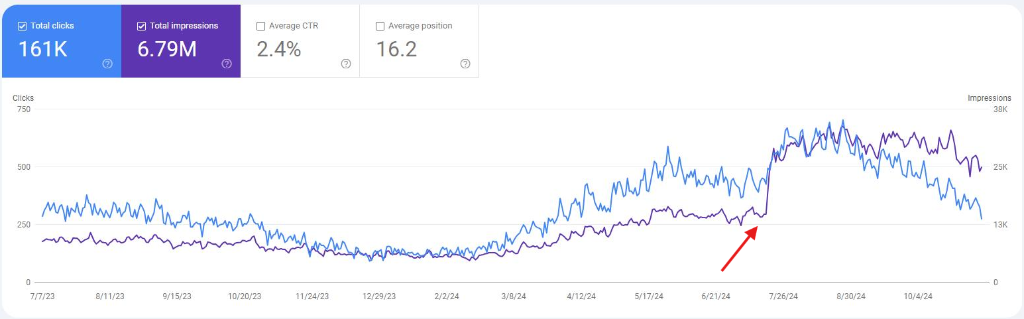
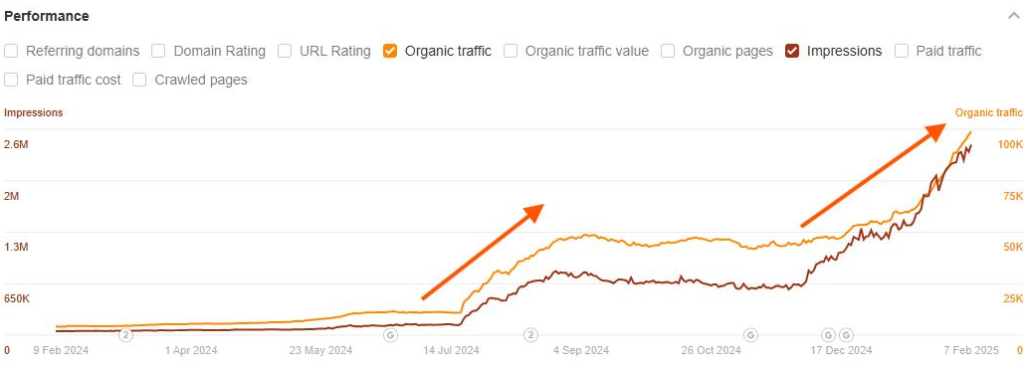
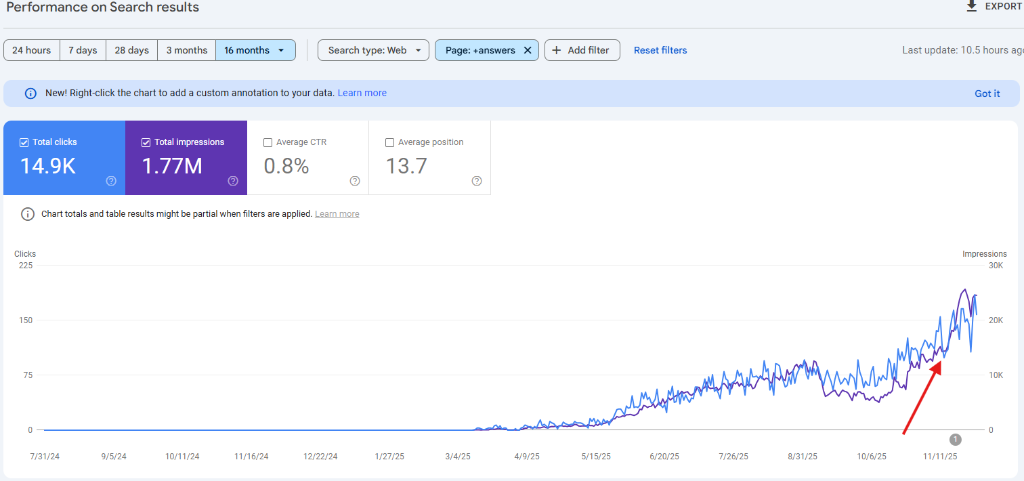
Each overnight spike aligns with a Google update that rewarded people-first, expert content — the exact kind of content Answerbase generates from real customer demand. The pattern has not flattened. The December 2025 core update produced the steepest lift yet.
The Missing Piece Most SEO Strategies Ignore
Three compounding problems in how content was being created — each of which pushed content further from what Google wanted and further from what customers needed. Together they produced the content crisis the Helpful Content Update was designed to address.
"Keyword Research" Instead of "Intent Research"
Traditional SEO processes work in reverse: (1) do keyword analysis, (2) find volume, (3) guess at what customers might want to read. Companies and the agencies they employ who are doing things right understand that "keyword research" is just a part of the process and that "intent research" is really what should be happening. The audience's demand and interest for information needs to come first for the content to deliver value.
"Content that is beneficial to the website owner but not necessarily the website visitor."
— Google's Search Quality Ratings Guidelines — definition of Lowest Quality Content
The Writer Expertise Problem
Content creation follows a tiered reality: Writers & Editors have writing skill but no topic expertise. Subject Matter Experienced Writers can communicate without sounding unknowledgeable but lack original insights. Subject Matter Knowledgeable Experts have the expertise but not the writing or marketing skills. Unicorns — writers who are both — are extremely rare and expensive. The result: most published content demonstrates writing expertise as opposed to topic expertise, and Google's Search Raters are specifically trained to identify the difference.
"For most pages, the quality of the MC can be determined by the amount of effort, originality, and talent or skill that went into the creation of the content."
— Google's Search Quality Ratings Guidelines
80% of Searches Are for Information — and Content Is Failing Them
80% of Google's searches are for information ("Know Queries"). Over 70% of all queries are long-tail, with highly specific intent behind each search. Most content creators focus on short-tail queries because of the volume — and create long-format articles that force searchers to sift through excessive filler to find the specific answer they came for. Google explicitly flags content with "excessive filler" as Low Quality.
"Are you writing to a particular word count because you've heard or read that Google has a preferred word count? (No, we don't)."
— Google Helpful Content Update
These are the modern names for those problems: Customer Demand Intelligence (start from what customers actually ask), Search Demand Intelligence (map that to real search queries), and Knowledge Gap Analysis (find where your content is failing to answer). Together they replace keyword-first thinking with intent-first thinking.
The Evolution Toward Product Knowledge
Search did not jump from keywords to AI overnight. It moved through a clear progression — each stage a response to the limits of the one before it. Understanding the progression is understanding why Product Knowledge is not a tactic, but the natural destination of the entire journey.
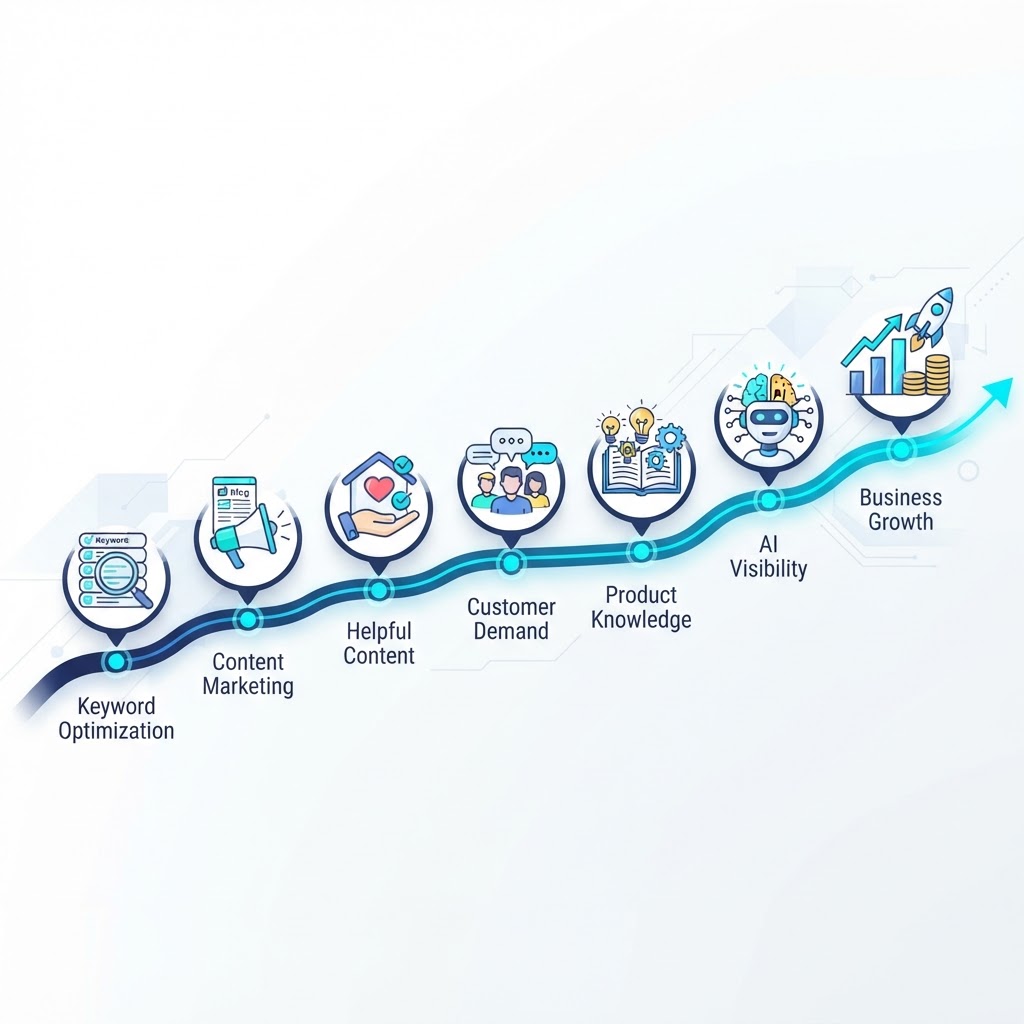
Keyword Optimization
Stuffing pages with target terms to match queries.
Content Marketing
Publishing articles to attract traffic and links.
Helpful Content
Writing for people, rewarded by the Helpful Content system.
Customer Demand
Starting from what buyers actually ask.
Product Knowledge
Structuring expertise into authoritative answers.
AI Visibility
AI systems retrieving and citing that knowledge.
Business Growth
Visibility, traffic, and conversions compounding.
Why AI Accelerated Everything
AI systems rely even more heavily on authoritative Product Knowledge than traditional search ever did. A link-based result can send a visitor to a mediocre page; a generative answer has to pull something worth citing. That single difference raised the bar for every piece of content on the web — and rewarded the merchants who had been building real knowledge all along.
Google AI Overviews
Synthesizes answers from authoritative product pages and cites them directly.
ChatGPT
Retrieves structured Product Knowledge to answer shopping questions.
Gemini
Summarizes expert content into recommendations and comparisons.
Claude
Favors well-structured, expert explanations over marketing copy.
Perplexity
Builds answer-engine responses from cited, authoritative knowledge.
Merchant Search
Surfaces complete, well-described products in shopping results.
Every search engine is converging on the same goal: understanding and retrieving authoritative knowledge. Google, ChatGPT, Gemini, Claude, and Perplexity differ in interface, but not in what they want. They all want the same thing Google always wanted — trustworthy answers from genuine expertise. AI simply made the demand impossible to fake.
How Leading Merchants Should Respond
The right response to the evolution of search is not a tactic — it is an operating model. Leading merchants do not chase algorithms. They build a repeatable practice that turns customer demand and expert knowledge into authoritative Product Knowledge, over and over. This is the strategic framework.
Demand Layer
Knowledge Layer
Distribution Layer
Measurement Layer
Understand customer demand
Discover the real questions and concerns buyers express across every channel.
Capture expert knowledge
Turn the expertise inside your team into structured, publishable answers.
Build Product Knowledge
Organize that expertise into authoritative knowledge for every product.
Distribute Product Knowledge
Publish it across product pages, FAQs, descriptions, and AI-ready formats.
Measure results
Track engagement, rankings, and conversions tied to the knowledge you built.
Improve continuously
Feed what you learned back in — and close the next knowledge gap.
This framework is the strategy. The only question that remains is how to operationalize it at scale — which is exactly the problem Answerbase was built to solve.
How Answerbase Fits
Answerbase is the Product Knowledge Platform — built to operationalize the framework above. It does not replace your expertise; it captures, structures, and distributes it. Each capability below is one part of that operating model. You do not need to learn them all at once — continue exploring wherever your strategy begins.
Frequently Asked Questions
The core questions about how search changed, why Product Knowledge replaced traditional SEO, and what it means for ecommerce.
Read the next chapter
Each chapter builds on the previous one, guiding you from the evolution of search to building a complete Product Knowledge strategy.
See how Answerbase fits your product knowledge strategy
This is one part of the Answerbase Product Knowledge platform. Request a demo to see how every capability works together.
