How to Build a Product Knowledge Strategy
for Modern Ecommerce
Great content is never created by accident — it is built systematically, with a process for understanding demand, creating helpful answers, measuring results, and improving. This guide synthesizes that philosophy into a practical framework merchants can actually execute. Product Knowledge is not another content initiative. It becomes an operating system for continuously improving customer experience, AI visibility, search visibility, and conversions — an asset that compounds rather than a campaign that decays.
Most Content Strategies Fail
Many businesses still operate like this: brainstorm topics, write content, publish, and repeat. The problem is that this approach produces disconnected content that rarely compounds. Each piece is created in isolation, answers no specific question, measures no real outcome, and feeds no learning back into the next piece. The result is a library of pages that exist but do not help — exactly the kind of content search engines and AI systems increasingly ignore.

Brainstorm Topics
Ideas chosen by guesswork, not by customer demand.
Write Content
Content created to match keywords, not to answer questions.
Publish
Published once, then abandoned.
Repeat
The cycle restarts with no learning from the last cycle.
This approach produces disconnected content that rarely compounds. Each piece starts from scratch, answers no measured demand, and teaches the business nothing about what to create next. The library grows, but the asset does not. The Product Knowledge Strategy replaces this cycle with a system where every piece builds on the last.
The Product Knowledge Strategy
A disciplined process: understand demand, create helpful content, measure results, and improve. The Product Knowledge Strategy is that process made into a complete operating model. Every stage feeds the next, and the final stage feeds back to the first — so the system learns from itself and compounds over time. This is the framework that turns Product Knowledge from a philosophy into a repeatable practice.

Understand Customer Demand
Capture the questions buyers actually ask across every channel.
Understand Search Demand
Map that demand to real search queries across Google and AI.
Identify Knowledge Gaps
Compare what buyers need to know against what you already answer.
Prioritize Opportunities
Score gaps by demand, revenue impact, and competitive value.
Generate Knowledge
AI creates first drafts from existing product data and context.
Capture Expert Contributions
Qualified specialists add real experience and original insight.
Publish Everywhere
Distribute canonical answers across every channel and format.
Measure Results
Track engagement, rankings, conversions, and AI visibility.
Improve Continuously
Feed results back in to prioritize the next gap and strengthen the base.
Start With Customer Demand
The principle is clear: content should be created to help people, not to manipulate rankings. That means demand — not keywords — should determine priorities. Customer demand is the raw material from which Product Knowledge is built. It comes from every channel where customers interact with your business, and every signal is an opportunity to create knowledge that genuinely helps.

Customer Questions
The most direct signal of what buyers need to know.
Search Demand
What people are searching for across Google and AI.
Reviews
What customers say after using the product.
Support
Recurring issues that signal knowledge gaps.
Community
Authentic customer-to-customer discussions.
Sales
Objections and questions that prevent purchases.
Retail Associates
Front-line experience with real buyers.
Competitors
Gaps in their knowledge you can fill.
AI Conversations
What buyers ask AI systems about your products.
These inputs become Product Knowledge opportunities. Every question, review, support ticket, and sales conversation is a signal of what buyers need to know. The strategy is to capture these signals systematically, map them to search demand, and prioritize the ones that create the most value — rather than guessing what to write next.
Prioritize High-Value Knowledge
Vanity metrics — content that makes companies feel good but delivers no real conversion attribution — should be rejected. The same principle applies to prioritization: not every question deserves equal attention. The Product Knowledge Strategy scores each opportunity by its real business value, so you invest your effort where it matters most. This is how a knowledge base becomes an asset rather than a volume exercise.

Search Demand
How many people are searching for this answer?
Customer Demand
How often do real buyers ask this question?
Knowledge Gap
How badly is this answer missing from your content?
Revenue Impact
How much revenue does answering this unlock?
Conversion Influence
Does this answer directly prevent purchase hesitation?
Support Reduction
Will this answer deflect future support tickets?
AI Visibility
Will AI systems cite this answer over competitors?
Opportunity Scoring combines these factors into a single score for each potential answer, so you always know which knowledge gap to close next. This is what transforms Product Knowledge from a guessing game into a measured practice. Learn about Product Knowledge Intelligence →
Automate What Can Be Automated
Google said appropriate use of AI is not against its guidelines — what it penalizes is AI used to manipulate rankings. The Product Knowledge Strategy uses AI as an accelerator, not a replacement. AI handles speed and scale. Experts handle experience and judgment. The combination is what creates genuine Information Gain at a pace no manual process can match.

AI Should
Discover Opportunities
AI surfaces questions and gaps across every channel automatically.
Draft Answers
AI generates first drafts from existing product data and context.
Summarize Knowledge
AI synthesizes reviews, discussions, and expertise into structured answers.
Recommend Improvements
AI recommends which knowledge gaps to close next.
Identify Gaps
AI compares what buyers need against what you have answered.
Experts Should
Add Experience
Experts contribute real-world knowledge AI cannot create.
Validate Accuracy
Experts ensure every answer is correct before it is published.
Contribute Original Knowledge
Experts provide the Information Gain that wins search and AI.
Approve Publication
Experts control what reaches the customer.
AI is an accelerator — not a replacement. Generic AI content has no Information Gain. Expert-refined AI content has genuine experience, original insight, and real value. The strategy is to let AI do what it does best — discover, draft, summarize, recommend — and let experts do what only they can do — add experience, validate, and approve.
Distribute Knowledge Everywhere
Helpful content should reach people where they are looking for it. The Product Knowledge Strategy takes this further: one piece of Product Knowledge becomes many assets. A single canonical answer is captured once and published across every channel where customers, search engines, and AI systems might look for it. This is what makes Product Knowledge an operating system rather than a content project.
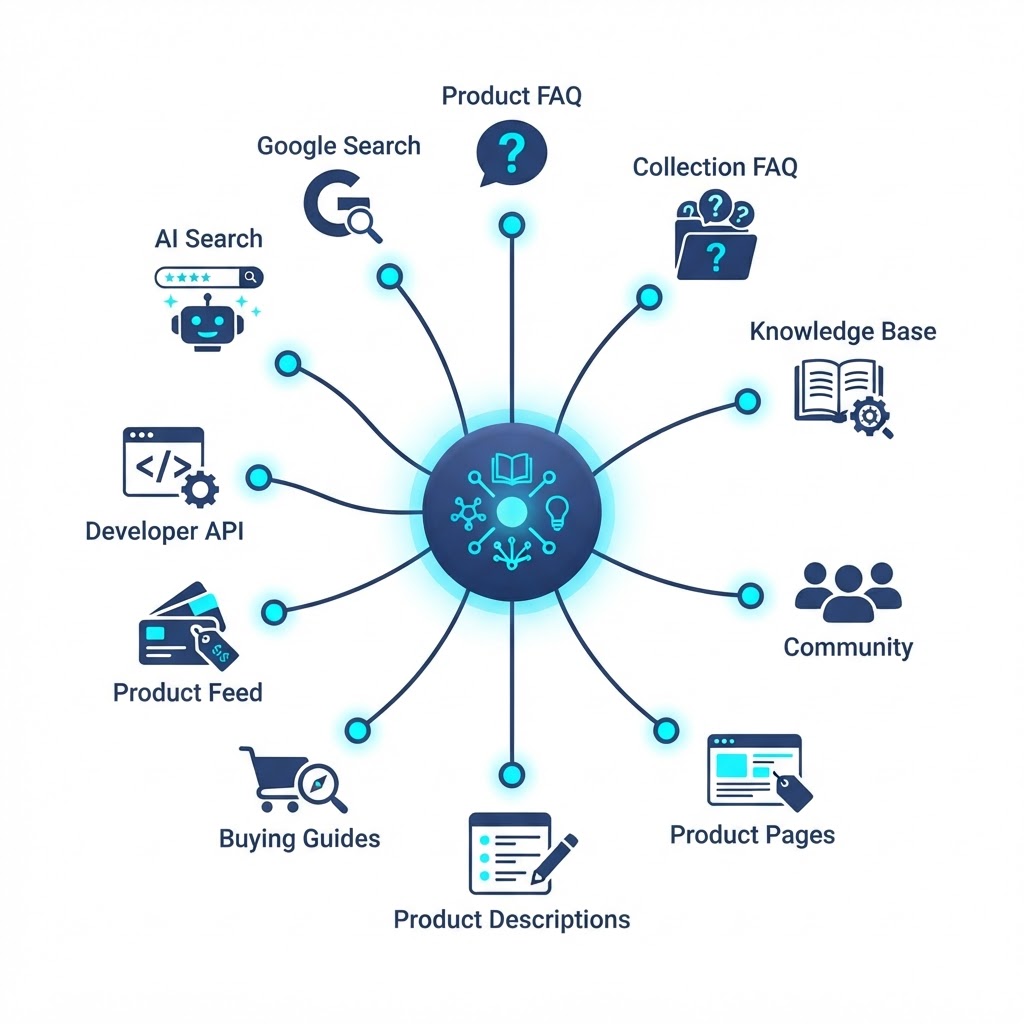
Product FAQ
Answers on the product page where buyers decide.
Product FAQ
Live questions and answers that build social proof.
Collection FAQ
Answers on category pages for broader questions.
Knowledge Base
A searchable library for self-service support.
Community
Customer-to-customer discussions that compound.
Buying Guides
Guides that help buyers choose the right product.
Product Feed
Structured data for shopping channels and feeds.
Developer API
Knowledge accessible to every system you build.
Future AI Channels
AI-ready formats for the next generation of search.
Capture once. Publish everywhere. This is the principle that makes Product Knowledge efficient. Instead of creating separate content for every channel, you create one canonical answer and distribute it everywhere. The answer works for SEO, AI, support, sales, and the customer simultaneously — and every improvement flows to every channel at once.
Measure Product Knowledge
Vanity metrics — content that makes companies feel good with impressions and clicks but delivers no real conversion attribution — should be rejected. The Product Knowledge Strategy measures the asset, not the activity. The goal is not measuring content volume. The goal is measuring the health, coverage, and business value of the knowledge you are building. This is what turns Product Knowledge from a project into a managed asset.
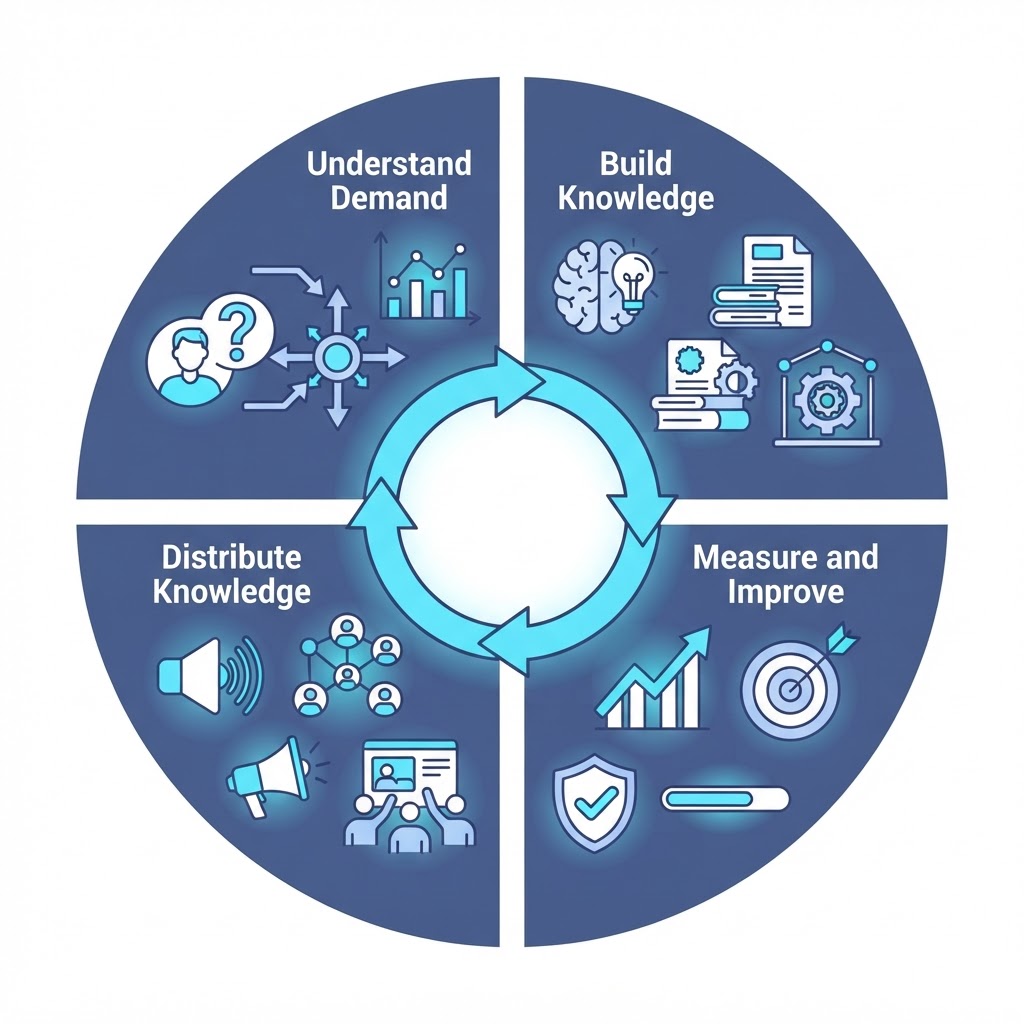
Knowledge Coverage
How much of your catalog has published Product Knowledge.
Knowledge Quality
Whether your answers genuinely help buyers decide.
Knowledge Gaps
Where customer demand exceeds your current knowledge.
Customer Demand Fulfilled
Whether the questions buyers ask are actually answered.
AI Visibility
Whether AI engines retrieve and cite your knowledge.
Search Visibility
Whether your knowledge earns and maintains rankings.
Conversion Attribution
Whether answered questions drive measurable revenue.
Support Reduction
Whether published answers deflect future tickets.
Knowledge Growth
Whether your knowledge base is expanding over time.
Product Knowledge Intelligence is the measurement system that tracks all of this across your entire catalog — so you can see the asset you are building, not just the pages you are publishing. It measures coverage, quality, gaps, demand fulfilled, AI visibility, search visibility, conversion attribution, support reduction, and knowledge growth in one view. Learn about Product Knowledge Intelligence →
Answerbase Operationalizes The Strategy
The strategy is a framework before it is a product. Answerbase is the platform that makes it operational — mapping every stage of the Product Knowledge Strategy to a specific capability. Together, these capabilities turn the framework from a whiteboard diagram into a daily practice your organization can run automatically.
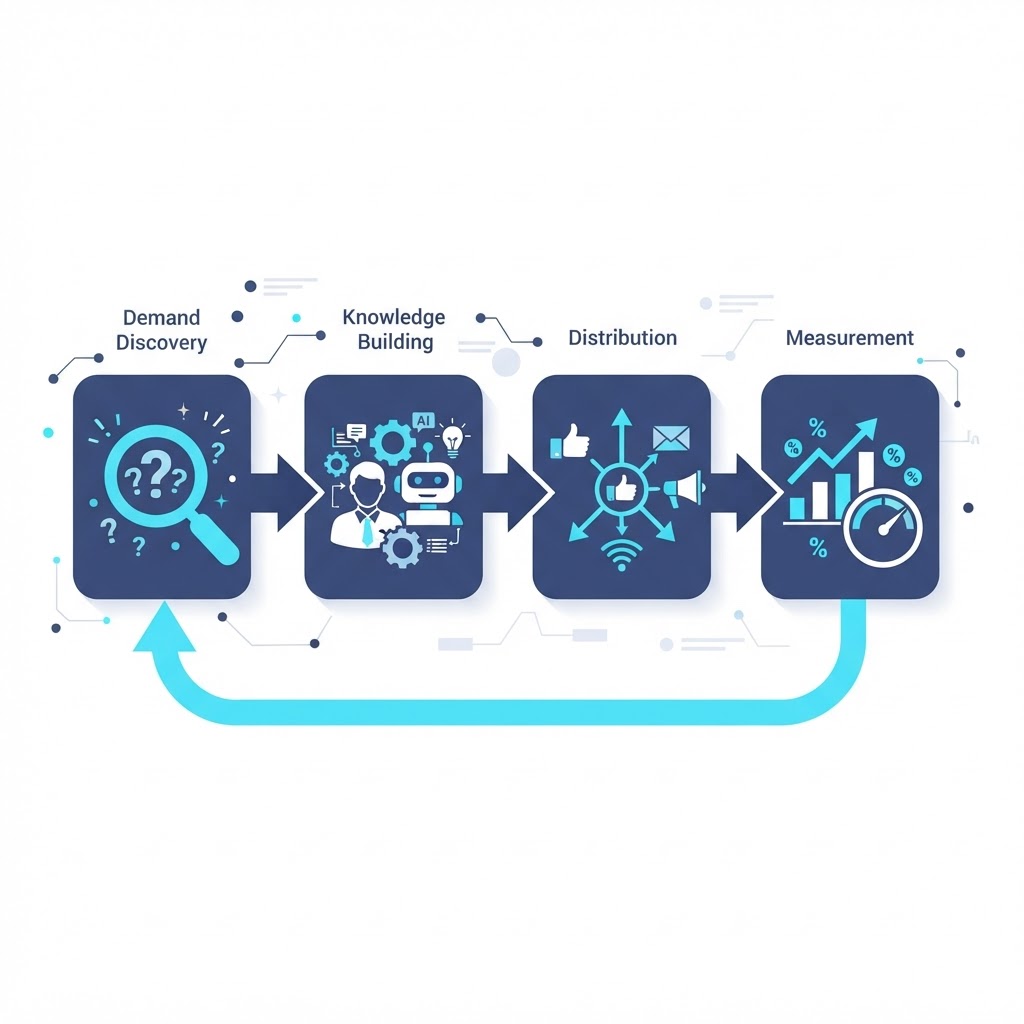
Understand Demand
Capture customer and search demand across every channel.
Build Knowledge
Generate, refine, and capture expertise as Product Knowledge.
Distribute Knowledge
Publish canonical answers across every channel and format.
Measure & Improve
Track the health and value of your knowledge asset continuously.
Winning in modern search is no longer about publishing more content. It is about systematically discovering, building, distributing, and continuously improving Product Knowledge that helps customers make better buying decisions.
Frequently Asked Questions
The core questions about building, prioritizing, automating, and measuring a Product Knowledge strategy.
AI Visibility & Discoverability: Why Product Knowledge Wins in the Age of AI Search
Why AI expands search rather than replacing it — and why the businesses with the best Product Knowledge become the most discoverable.
How to Measure Product Knowledge
How to measure whether your Product Knowledge is actually improving — beyond rankings, traffic, and content volume.
See how Answerbase fits your product knowledge strategy
This is one part of the Answerbase Product Knowledge platform. Request a demo to see how every capability works together.
