The Product Knowledge Flywheel:
Why Great Product Knowledge Compounds Over Time
Most companies think of content as projects — campaigns that launch, spike, and decline. Leading companies think of Product Knowledge as an asset that compounds. Google "continues to get more sophisticated" in rewarding helpful content. The natural extension of that observation is a flywheel: every customer question, every expert contribution, every review, and every support interaction makes the Product Knowledge ecosystem stronger. Unlike a campaign that begins losing value the day it launches, Product Knowledge becomes increasingly valuable over time.
Content Is Temporary. Product Knowledge Compounds.
A clear line can be drawn between content created for search engines and content created for people. The same line separates traditional content from Product Knowledge. Traditional content is a project with a beginning and an end. Product Knowledge is a system with no end — every cycle makes the next cycle more valuable. The difference is not just tactical. It is the difference between an expense and an asset.
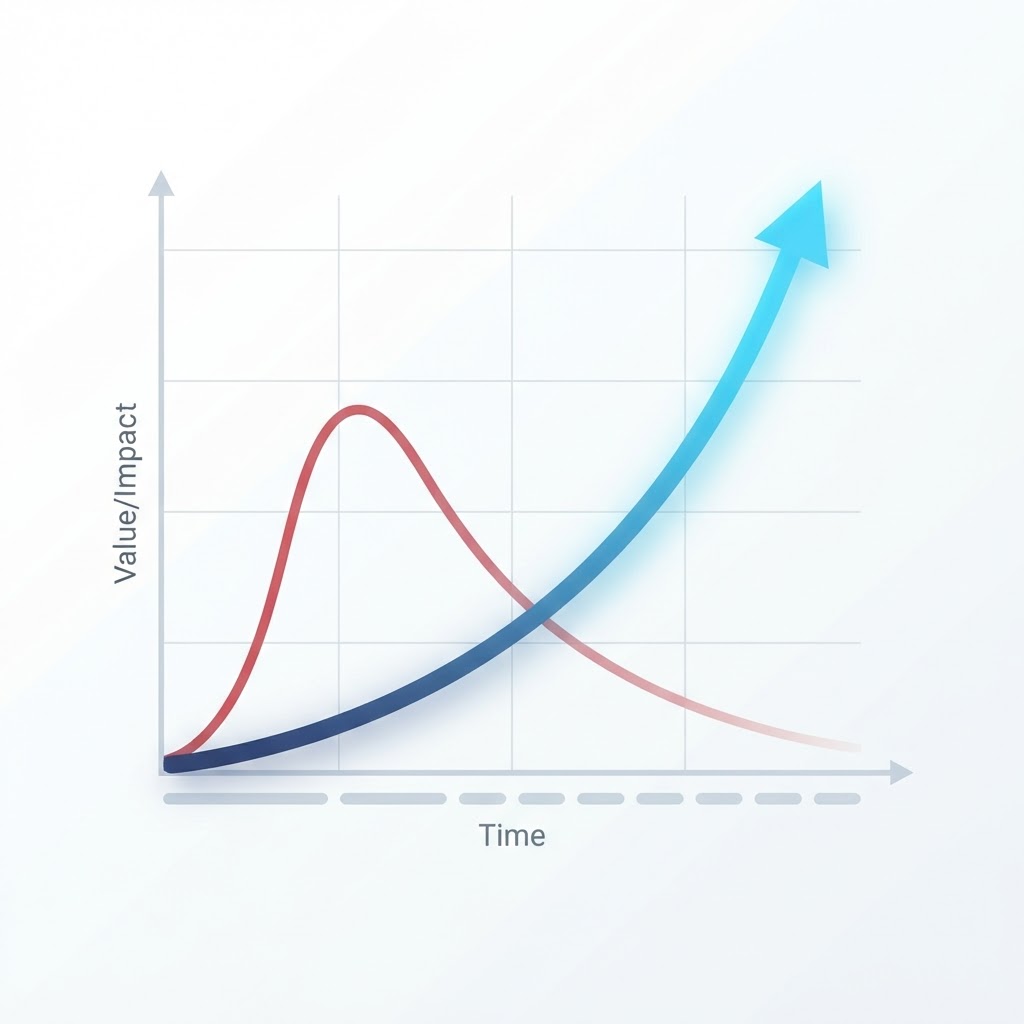
Traditional Content
Campaign
A content project is planned and launched.
Publish
The content goes live and begins attracting traffic.
Traffic Spike
Rankings and visits peak shortly after launch.
Decline
The content decays, gets abandoned, and loses value.
Product Knowledge
Customer Demand
Real questions reveal what buyers need to know.
Knowledge Creation
Expertise is captured into authoritative answers.
Publishing
Answers are distributed across every channel.
Continuous Learning
Engagement reveals new gaps and new demand.
Continuous Expansion
New knowledge is added; existing knowledge improves.
Increasing Business Value
The asset compounds across search, AI, and revenue.
Every Customer Interaction Makes You Smarter
Google "continues to get more sophisticated in their ability to digest the feedback from their Search Quality Raters and adjust their automated ranking signals." Product Knowledge works the same way — every customer interaction is feedback that makes the system smarter. Most businesses treat these interactions as costs to be resolved. Leading businesses treat them as inputs to be captured. Each one reveals another opportunity to improve.
New Customer Question
A question reveals information your product page is missing.
Compatibility Issue
A buyer is unsure whether two products work together.
Installation Confusion
A customer struggles to set up the product correctly.
Support Ticket
A recurring issue signals a gap in published knowledge.
Negative Review
A complaint highlights something buyers need to know.
Community Discussion
Customers share real-world experience you can capture.
Product Comparison
A buyer hesitates between two options and needs guidance.
Buying Hesitation
An unanswered question prevents a purchase from happening.
Each interaction reveals another opportunity to improve Product Knowledge. A question you answer once and publish helps every future customer with the same question — and feeds the signal that tells you what to answer next. The businesses that capture these inputs build a knowledge base that gets smarter every day.
The Product Knowledge Flywheel
A continuous cycle: understand demand, create helpful content, measure results, and improve. The Product Knowledge Flywheel is that cycle made permanent. Every turn produces more knowledge, more engagement, and more demand signals — which feed the next turn. This is why the flywheel becomes increasingly difficult for competitors to replicate: the longer you run it, the further ahead you pull.
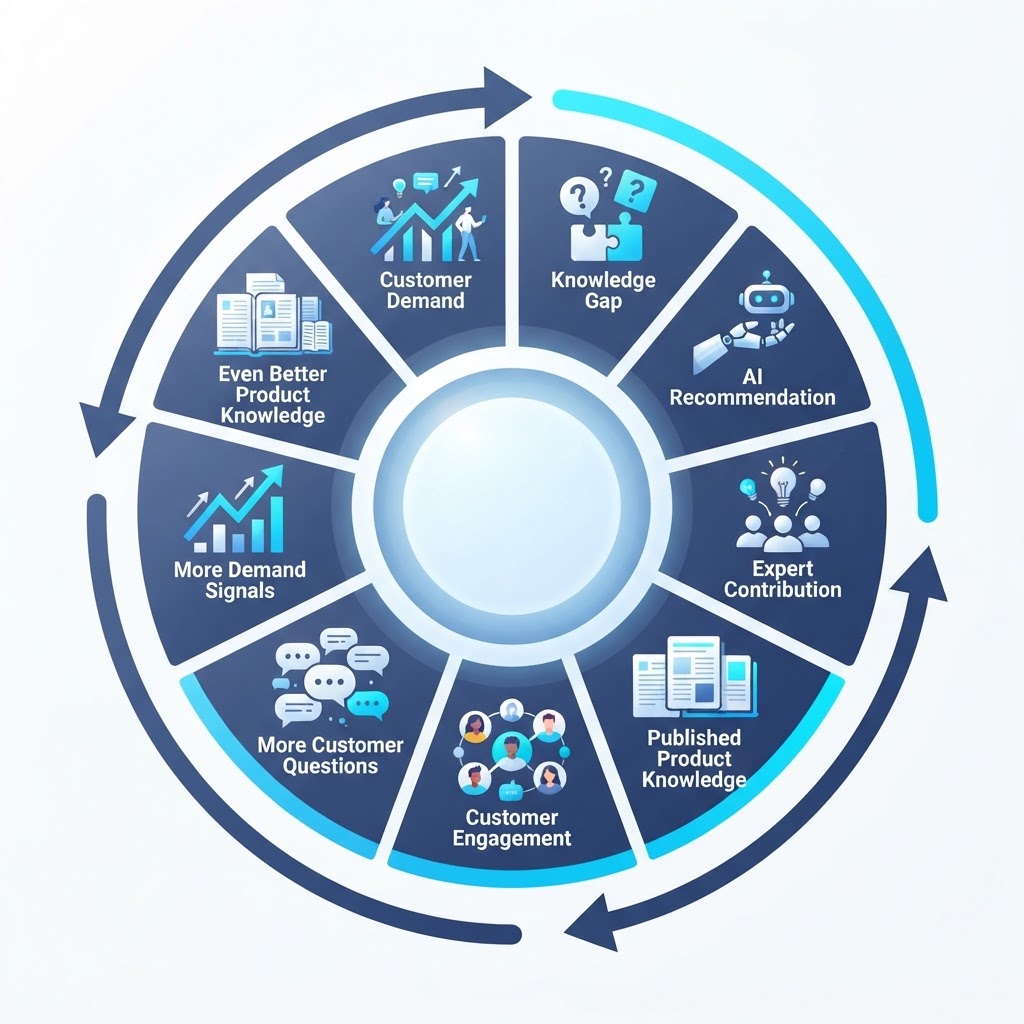
Customer Demand
Buyers reveal what they need to know through real interactions.
Knowledge Gap
Each question identifies a gap in your current Product Knowledge.
AI Recommendation
AI surfaces the gap and recommends where to invest next.
Expert Contribution
The qualified specialist adds real experience and insight.
Published Product Knowledge
A canonical answer becomes the source of truth.
Customer Engagement
Published answers generate questions, conversions, and feedback.
More Customer Questions
Engagement surfaces new questions and new demand.
More Demand Signals
New signals reveal new gaps and new opportunities.
Even Better Product Knowledge
The cycle repeats — and the knowledge base grows stronger.
This is why the flywheel becomes increasingly difficult for competitors to replicate. A competitor can copy a single webpage. They cannot copy years of customer interactions, expert insights, community discussions, compatibility knowledge, and continuously improving Product Knowledge. The flywheel is not a tactic — it is an accumulated advantage that compounds with every turn.
The Compounding Business Benefits
Product Knowledge is not simply an SEO investment. It is an organizational asset that simultaneously improves every function that touches the customer. People-first content serves the customer first — and the ripple effect is that it serves the entire business. As the flywheel turns, every department benefits from the same growing knowledge base.
Google Search
Demand-driven knowledge earns rankings that persist and grow.
AI Search
Authoritative answers get retrieved and cited by AI engines.
Customer Confidence
Answered questions build the trust needed to commit.
Conversions
Knowledge at the moment of decision removes purchase friction.
Customer Support
Published answers deflect tickets before they are created.
Employee Productivity
Shared knowledge replaces repetitive one-on-one answers.
Sales Enablement
Published objection-handlers help close deals at scale.
Product Discovery
Knowledge helps buyers find the right product faster.
Repeat Purchases
Confident customers return to merchants they trust.
Knowledge Retention
Expertise is captured, not lost when employees leave.
Product Knowledge is not simply an SEO investment — it becomes an organizational asset. A single piece of Product Knowledge works for SEO, AI, support, sales, and the customer simultaneously. The ROI is not measured in one channel but across all of them, compounding as the knowledge base grows.
Why Competitors Can't Easily Catch Up
Information gain — content that provides new, useful information not already available elsewhere — is the foundation. Product Knowledge is the ultimate expression of information gain. It accumulates over years from interactions no competitor has had. A competitor can copy a webpage. They cannot easily copy years of customer questions, expert insights, community discussions, compatibility knowledge, and troubleshooting experience. The flywheel is a moat.
Years of customer interactions
Competitors can copy a page. They cannot copy the thousands of real customer questions, concerns, and objections you have captured over years of commerce.
Accumulated expert insights
The expertise of your product specialists, support staff, and industry experts is captured in your knowledge base. That depth of experience cannot be hired or copied overnight.
Community discussions
Real customer-to-customer conversations contain real-world experience no competitor can fabricate. Google reserves its highest ratings for content with multiple perspectives.
Why a webpage is not a moat
A competitor can replicate a single product page in an afternoon. They cannot replicate the continuously improving knowledge ecosystem behind it — because that ecosystem is built from interactions they have not had.
The longer you run the flywheel, the wider the moat becomes. Every month, your knowledge base grows richer while a competitor starting from scratch has nothing to retrieve, nothing to cite, and nothing to rank. Time is the ingredient that cannot be shortcut.
Why AI Makes The Flywheel Faster
Google itself said appropriate use of AI is not against its guidelines — what it penalizes is AI used to manipulate rankings. AI used to accelerate genuine expertise is exactly what Google rewards. AI does not replace expertise. It accelerates the Product Knowledge Flywheel — making every stage faster, cheaper, and more scalable without sacrificing the human knowledge that makes the content valuable.
Question Discovery
AI surfaces the questions customers are asking across every channel — automatically.
Draft Creation
AI generates first drafts from existing product data, reducing expert effort to review.
Knowledge Recommendations
AI recommends which knowledge gaps to close next, prioritized by business value.
Gap Analysis
AI compares what customers need to know against what you have already answered.
Summarization
AI synthesizes reviews, discussions, and expertise into structured answers.
Knowledge Distribution
AI formats answers for product pages, FAQs, descriptions, and AI-ready schemas.
AI doesn't replace expertise — it accelerates the Product Knowledge Flywheel. The expert still provides the insight; AI handles the speed. Drafts are generated in seconds, gaps are surfaced automatically, and distribution is formatted for every channel. The human knowledge that makes content valuable is preserved. The time it takes to capture and publish it is compressed.
How Answerbase Powers The Flywheel
The flywheel is a philosophy before it is a product. Answerbase is the platform that makes it operational — turning the cycle into a repeatable, measurable practice. Every capability in the platform strengthens one stage of the flywheel. Together, they make the compounding effect automatic rather than manual.
Customer Demand Intelligence
Capture and measure the questions customers actually ask.
Search Demand Intelligence
Map that demand to real search queries across Google and AI.
Knowledge Gap Analysis
Identify where your knowledge fails to answer what buyers need.
AI Drafts
Generate first drafts from existing product data and context.
Expert Knowledge Capture
Route to qualified specialists for real experience and correction.
Distribution
Publish canonical answers across every channel and format.
Measurement
Track engagement, rankings, conversions, and AI visibility.
Continuous Improvement
Feed results back in to prioritize the next gap and strengthen the base.
How Merchants Should Think About Product Knowledge
Vanity metrics — content that makes companies feel good with impressions and clicks but delivers no real conversion attribution — should be rejected. The same principle applies to how you measure Product Knowledge. Stop measuring activity. Start measuring the health, coverage, and business value of the asset you are building.
Stop Measuring
Pages Published
Articles Written
Keywords Ranked
Start Measuring
Knowledge Coverage
Knowledge Quality
Knowledge Gaps
Customer Confidence
Demand Fulfilled
AI Visibility
Search Visibility
Conversions
Product Knowledge Intelligence is the future of measurement. It measures the coverage, completeness, quality, and business value of your Product Knowledge across your entire catalog — so you can see the asset you are building, not just the pages you are publishing. Learn about Product Knowledge Intelligence →
Frequently Asked Questions
The core questions about the Product Knowledge Flywheel and why great Product Knowledge compounds over time.
Read the next chapter
Each chapter builds on the previous one, guiding you from the evolution of search to building a complete Product Knowledge strategy.
See how Answerbase fits your product knowledge strategy
This is one part of the Answerbase Product Knowledge platform. Request a demo to see how every capability works together.
