Why Ecommerce Sites Should Follow Amazon's Approach to Product Questions & AnswersAnd why Product Knowledge is the evolution beyond it
Amazon's conversion rates run around 4× the average ecommerce conversion rate — and their Product Questions & Answers strategy is a big reason why. Here is what Amazon does, why it works, and how modern Product Knowledge platforms improve upon Amazon's model.
Amazon vs. avg. conversion
of answered Q&A converts
higher LTV from Q&A traffic
 Shopify5.0
Highly Rated by Ecommerce Merchants
Helping Ecommerce Merchants Since 2013
How Amazon Product Questions & Answers engages customers
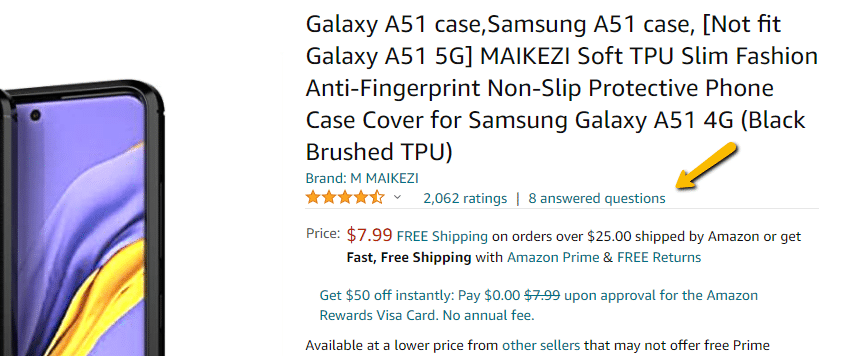
When you visit a product page on Amazon, you'll notice a preview of the product Q&A engagement right under the product title. That lets the visitor know the question & answer capability and content are available.
A bit further down the page there is a more "in your face" call to action right above the product details and specifications, where they ask the user to enter any product question through a simple field. This gives the customer the ability to ask their own specific question, removing any information barrier on their journey to purchasing. The tool autosuggests existing answers if the content is already available — saving them the time of reading through product descriptions and specifications to find it.

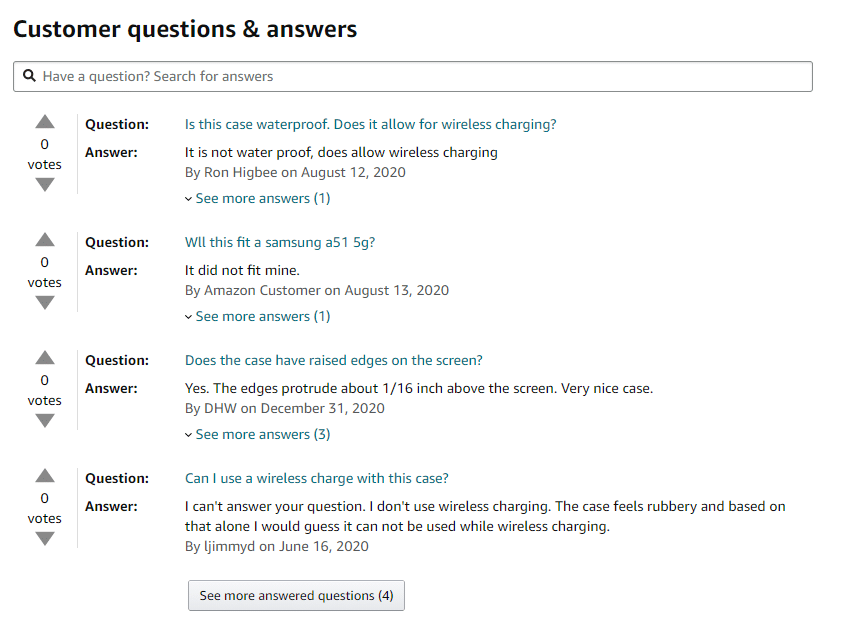
Finally, below all the product information the seller has made available, Amazon shows the full Customer Question & Answer functionality and content for that product. This gives the customer another engagement point to ask their question if they didn't find it above — and shows the current Q&A content available.
Why Amazon invested in Product Questions & Answers
Amazon did not add Q&A to its product pages as a courtesy. It invested in it because unanswered product questions are the single largest cause of lost sales — and answering them at scale is how Amazon turns uncertainty into conversion.
Why unanswered product questions kill conversions
A shopper with an unanswered question does not wait — they leave to find the answer on Google, and often land on a competitor. Every unanswered question is a conversion that walked out the door. This is why reducing bounce rates starts with answering questions.
Customer confidence is Amazon's competitive advantage
Amazon wins not because it has the lowest price, but because it removes the most uncertainty. A shopper who can get their specific question answered instantly buys with confidence — and confidence, not page design, is what drives conversion.
How Amazon uses Product Knowledge at scale
Amazon does not rely on sellers to write perfect descriptions. It layers customer questions, answers, reviews, and autosuggest over every product — building a knowledge layer that grows with every interaction. That layer is what makes Amazon's product pages feel complete no matter how thin the seller's original description. The lesson for merchants: the knowledge layer, not the description, is the asset.
Landing pages for each product Q&A thread
The first treasure hidden in Amazon's implementation has a notable impact on Q&A content getting indexed in Google and growing consistent traffic from customers asking similar product questions on search engines.
Look closely at how Amazon publishes Q&A content on the product page. The question title is a link:

When you click the link, it goes to a page dedicated to that specific Q&A thread:
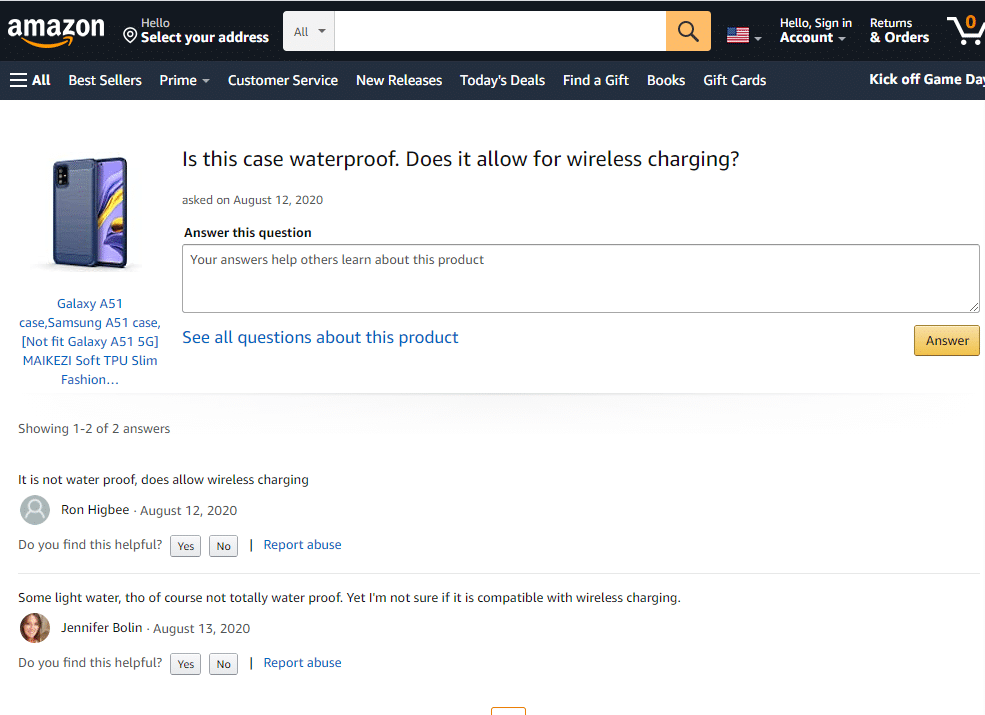
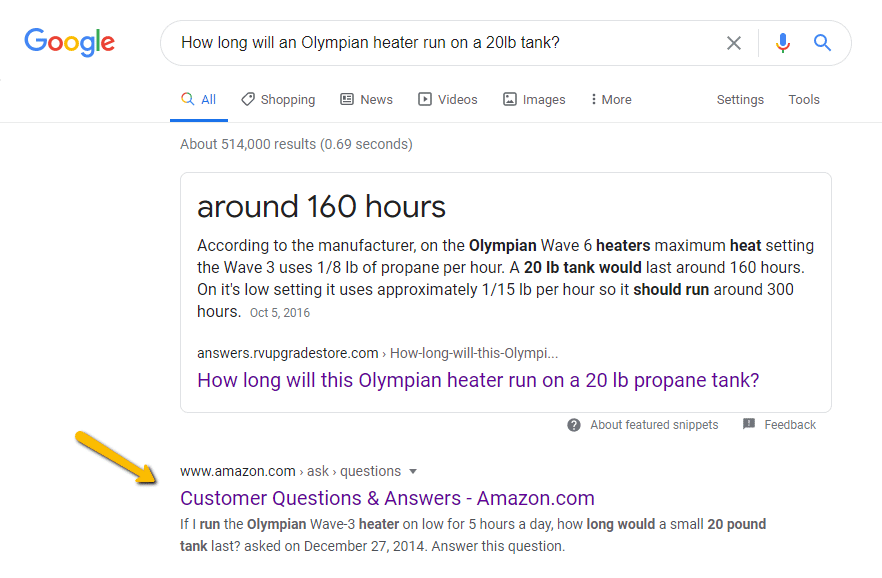
Having a specific page for every single product Q&A thread lets Google recognize the question title as anchor links to the question details page — so Google crawls, indexes, and shows those pages in search results when customers ask similar product questions. See an Amazon product Q&A landing page as the second organic search result here:
Where Answerbase extends Amazon: better-optimized landing pages
The first organic featured snippet above is an Answerbase customer — we power product Q&A landing pages for ecommerce merchants on their own subdirectory or subdomain, optimized for search with the appropriate page title and markup. Better-optimized pages lead to better matching and better click-through. Amazon's pages rank because of domain authority; yours can rank because of page-level optimization.

As a provider of product questions and answers, Answerbase has seen these landing pages significantly increase organic traffic to a merchant's store. In one case study, a customer increased organic traffic by over 4× previous levels — and Q&A content is now responsible for over half of the overall traffic to their site.
Another notable thing: the average lifetime value of customers coming in through product Q&A content is up to 2× higher than the customer's normal Google traffic — a signal of the intent of users asking those questions on search engines.
As a merchant you are wise to implement product Q&A on your site in a similar manner, so you can leverage all of the product knowledge of you and your team — and ensure that knowledge drives new traffic and conversions. See how this compounds in Increase Ecommerce Traffic.
Getting answers from all available product information
The second detail in how Amazon manages its product Q&A is uncovered when we look at the ask question field. When you start typing your question, it autosuggests answers — but it looks for those answers within all of the product information available.

That means it looks through the product description, product specifications, Q&A, reviews, and more — and ensures that if the information is currently available, it is presented to the customer to read. See an example of some results here:
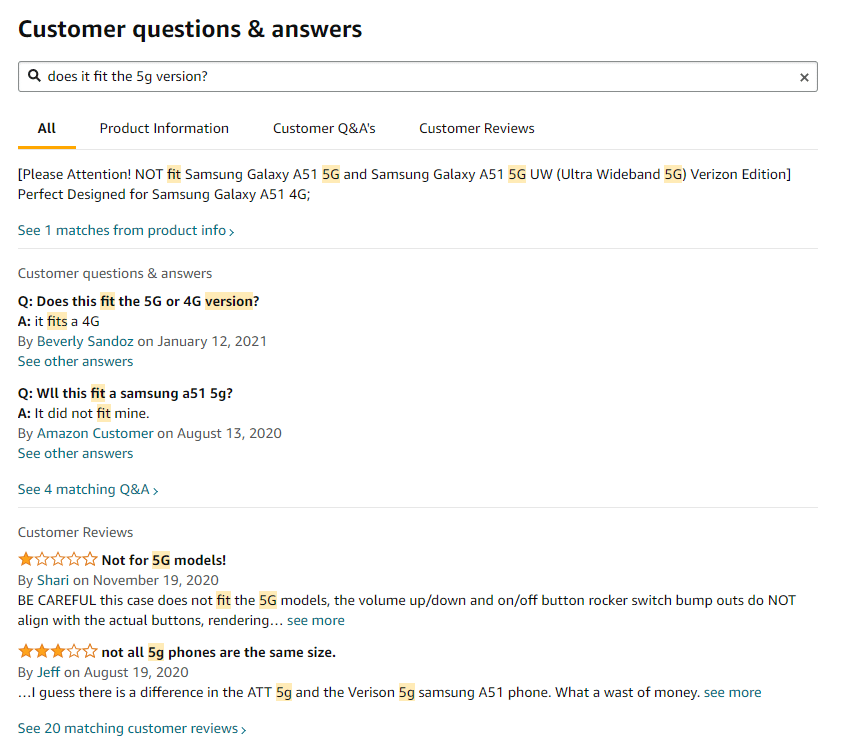
Instant answers, no waiting
This helps ensure the customer gets the answers they're looking for and doesn't have to wait for a response. It also reduces the number of questions the seller has to manage — while still converting the sales.
of answered questions convert to a sale
Answerbase sees that up to 75% of product questions answered convert to a new sale — so answering customer questions in the quickest possible way increases conversions and sales. See AI Knowledge Generation.
Amazon's model vs. modern Product Knowledge
Amazon proved the model. But Amazon's Q&A lives inside Amazon's walled garden — it drives traffic to Amazon, not to you. Modern Product Knowledge platforms take the same principles and make them work for your store, your domain, and your brand.
Product Questions vs Product Reviews
Reviews capture post-purchase opinion; questions capture pre-purchase demand. Amazon uses both, but questions are the lever that stops a bounce and saves a sale before it is lost. For merchants, prioritizing questions means prioritizing the exact gap that costs you conversions.
Product Questions vs FAQs
A static FAQ is a list of questions someone guessed. Product Questions are the real questions your shoppers actually ask — captured live, answered with expertise, and published as structured content that ranks and converts. See Ecommerce Product FAQs.
Where Answerbase extends Amazon's approach
- › Better-optimized landing pages — every Q&A thread becomes a search-optimized page on your domain, not Amazon's.
- › AI-assisted answer generation — recognize when you have already answered a question and auto-suggest it, so up to 80% of questions resolve instantly.
- › Customer Demand Intelligence — capture every question as a signal of what to build next.
- › Search Demand Intelligence — see what buyers search for before they arrive.
- › A continuously expanding Product Knowledge asset — owned by you, compounding over time.
- › SEO and conversions improved together — the same content that answers shoppers onsite ranks offsite.
AI answers & demand intelligence
Amazon's autosuggest answers from existing product information. Modern Product Knowledge platforms do the same — and then capture the demand behind every question so you know exactly what to build next.
AI-generated answers from product information
Answerbase recognizes when you have already answered a question within your product information and auto-suggests it — the same autosuggest Amazon uses, but working for your store and your domain.
Learn more →Customer Demand Intelligence
Every question a shopper asks is a signal of the information gap that stopped the sale. Capture and prioritize that demand so you build the knowledge that converts.
Learn more →Search Demand Intelligence
See what buyers search for before they arrive — so the content you add captures demand Amazon never sees.
Learn more →Product Feed Enrichment
Extend that knowledge into your product feed so it performs in Merchant Center and AI — not just on your product page.
Learn more →Why every answered question becomes future conversion content
Amazon's Q&A is a byproduct of its traffic. For you, every answered question is a new asset — a dedicated landing page that ranks, answers future shoppers, and keeps working long after the original conversation.
Dedicated landing pages
Every popular Q&A thread becomes its own indexed, optimized page — so the next shopper with the same question finds your store, not a competitor.
Product Knowledge for AI search
AI assistants and Overviews retrieve and cite unique, structured answers. Your Q&A gives them something only your store can provide — see AI Visibility.
Structured data benefits
Each Q&A page is published with proper structured data — enabling rich results, AI citations, and higher click-through from engaged visitors.
Helpful content that ranks and converts
Google's helpful content system rewards content that answers real questions. The Q&A that converts shoppers onsite is the same content Google ranks and AI cites — so improving conversions and improving helpful content become one motion. This is how Answerbase improves SEO while simultaneously improving conversions — something Amazon's walled-garden Q&A cannot do for your store.
The Product Knowledge Flywheel & measuring ROI
Amazon's Q&A runs inside Amazon. Your Product Knowledge runs inside your store — and compounds. Every question captured and answered makes the next shopper's journey shorter and your page more complete. The loop runs forever, and competitors cannot copy knowledge built from your own customers.
Why the flywheel beats Amazon's model
Amazon captures the knowledge; you never own it. With Answerbase, the knowledge asset is yours — on your domain, in your index, compounding your traffic and conversions year over year. The longer you run it, the harder it is for competitors to catch up. See the full Product Knowledge Flywheel.
Questions answered
Volume of customer questions resolved with published answers.
Auto-answer rate
Share of questions resolved instantly from existing product information.
Question-to-conversion
Share of answered questions that lead to a sale (up to 75%).
Q&A landing pages indexed
Dedicated pages earning organic impressions and clicks.
Organic traffic growth
Year-over-year traffic from Q&A content (up to 4× in case studies).
Customer lifetime value
LTV of Q&A-driven visitors vs. normal Google traffic (up to 2×).
For the full framework, see Measuring Product Knowledge and Product Knowledge Intelligence.
Amazon Product Q&A FAQ
The core questions ecommerce merchants ask about Amazon's Product Questions & Answers strategy and the Product Knowledge evolution.
Related Resources
See how Answerbase fits your product knowledge strategy
This is one part of the Answerbase Product Knowledge platform. Request a demo to see how every capability works together.

